
Tortoises are some of the longest-lived, most personality-rich pets you can keep — but they are also one of the most commonly misunderstood. People picture a low-maintenance shell on legs, munching lettuce in a shoebox. The reality is a 50-to-100-year commitment to an animal that needs UVB lighting, daily temperature gradients, a tortoise table or outdoor enclosure that grows as they do, and a diet that looks almost nothing like what pet-store caresheets from the 1990s recommended. That commitment gap is exactly why reptiles end up needing new homes — if you’re considering a tortoise, check who’s currently waiting for adoption before you buy.
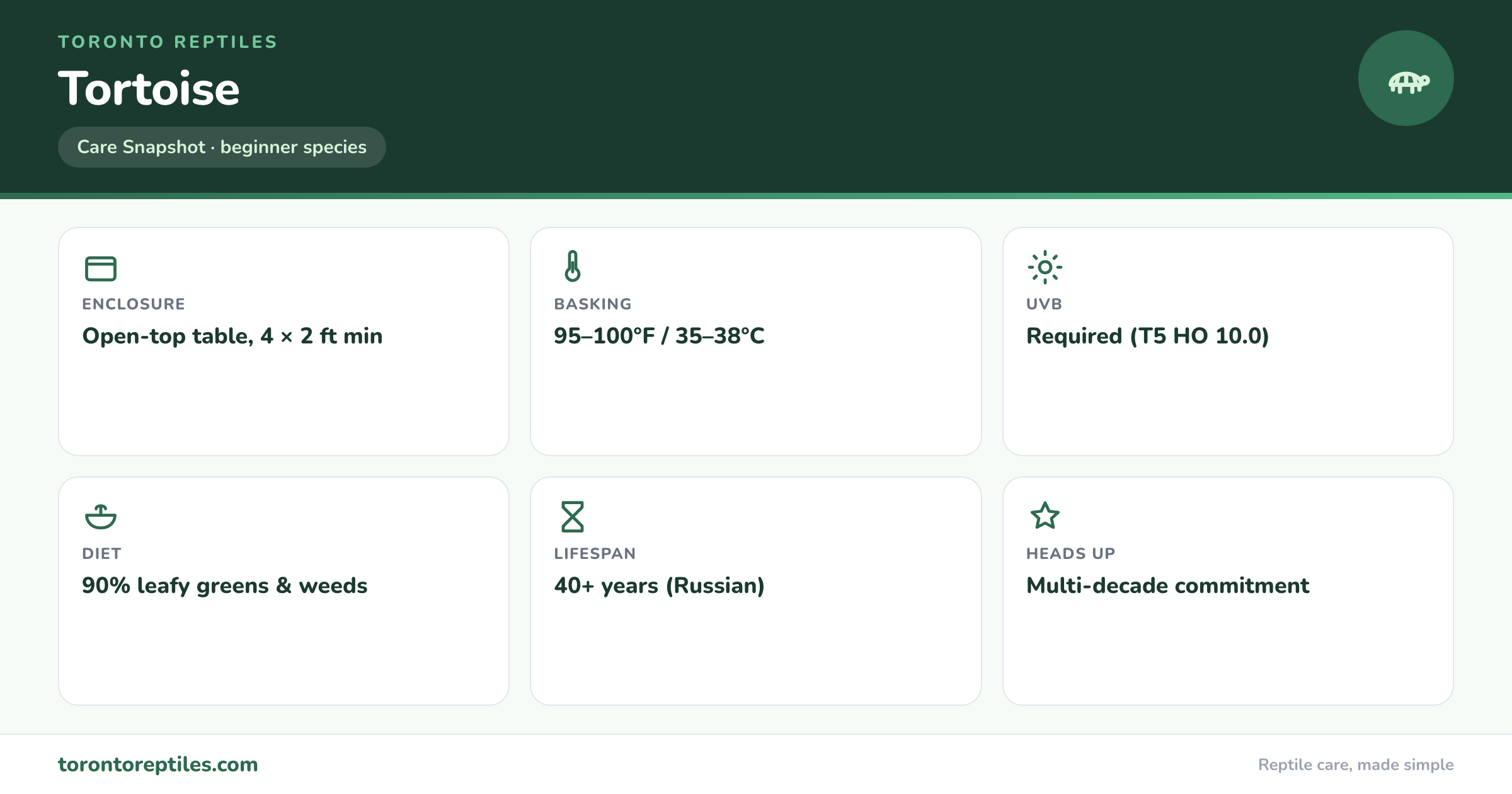
TL;DR: A tortoise is a 40-to-100-year commitment: a long, open tortoise table (not a glass terrarium), non-negotiable UVB lighting, and a diet that’s 90% leafy greens and weeds. Russian tortoises are the beginner pick; sulcatas outgrow almost every home.
None of that is meant to scare you off. Tortoises are genuinely rewarding — they recognize their keepers, learn routines, and are about as close to a “dinosaur in the living room” as most Canadians will ever get. The trick is setting up their world correctly from day one, because tortoise health problems almost always trace back to husbandry mistakes made in the first few months.
This guide is the one we wish every new tortoise keeper in the GTA had in front of them before bringing one home — it draws on our years caring for a Russian tortoise here in Toronto.
Key Takeaways
- Tortoises are a multi-decade commitment. Russian tortoises live 40+ years; sulcatas can outlive you. Our tortoise lifespan guide breaks down lifespans by species and the husbandry factors that determine whether your animal reaches that ceiling. Plan accordingly before you buy.
- Enclosure size is almost always wrong. A glass terrarium is the wrong shape — tortoises need a long, shallow, open-topped “tortoise table” at minimum 4 ft by 2 ft for small species.
- UVB lighting is non-negotiable. Without it, tortoises develop metabolic bone disease — a painful, often fatal condition caused by calcium deficiency.
- Diet is 90% leafy greens and weeds, not fruit, not lettuce, and definitely not dog food (yes, that used to be recommended).
- Species choice matters enormously. A Russian tortoise is beginner-friendly. A sulcata will grow to 200 lb and break through drywall. Pick the right species for your space.
Choosing the Right Species for a Canadian Home
Before anything else, decide which tortoise you are actually keeping. “Tortoise” is not a single animal — it is about 50 species with wildly different adult sizes, climate needs, and personalities. The four you will most often see offered in Ontario are Russian tortoises, Hermann’s tortoises, Greek (spur-thighed) tortoises, and red-footed tortoises. Sulcatas and leopard tortoises also show up in the trade, and they are a mistake for 95% of first-time keepers.
| Species | Adult Size | Lifespan | Climate | Beginner-Friendly? |
|---|---|---|---|---|
| Russian Tortoise | 15–25 cm (6–10 in) | 40+ years | Arid, temperate | Yes — top pick |
| Hermann’s Tortoise | 18–28 cm (7–11 in) | 50+ years | Mediterranean | Yes |
| Greek Tortoise | 15–28 cm (6–11 in) | 50+ years | Mediterranean | Yes, with care |
| Red-Footed Tortoise | 30–40 cm (12–16 in) | 50+ years | Tropical, humid | Intermediate |
| Sulcata Tortoise | 60–90 cm (24–36 in), up to 90 kg | 70–100 years | Hot, arid | No — avoid |
| Leopard Tortoise | 45–70 cm (18–28 in) | 50–100 years | Hot, arid | No |
Why Russian tortoises are the beginner gold standard
If we had to pick one species for a first tortoise, it’s the Russian tortoise — the species we kept ourselves. They stay small (under 25 cm even at full adult size), tolerate the dry, heated air of a Canadian home better than tropical species, hibernate naturally if given the option, and have bold, food-motivated personalities. A single adult Russian tortoise can live comfortably in a 4 ft x 2 ft tortoise table — a footprint most condos can manage.
Enclosure Setup: Why Glass Tanks Fail Tortoises
The single most common mistake new keepers make is buying a 40-gallon glass aquarium. Tortoises are terrestrial animals that need to walk in straight lines for a long time — a behaviour called “wall-pacing” that becomes pathological when they can see through walls but cannot cross them. They also need horizontal floor space, not vertical air space. A glass tank gives them the opposite of what they need.
The right answer is an open-topped tortoise table: a wooden, solid-sided enclosure, typically 4 ft x 2 ft (120 cm x 60 cm) minimum for a single adult Russian or Hermann’s tortoise. Open tops let UVB pass without filtering through plastic or glass, and solid walls remove the pacing trigger. Many Ontario keepers build their own from plywood for around $120 in materials. For the full enclosure build process — substrate depth, heat mapping, lighting placement, and humidity zones — our reptile enclosure setup guide covers tortoise-specific requirements in detail.
Substrate
For arid species (Russian, Hermann’s, Greek), use a 50/50 mix of organic topsoil and play sand at a depth of at least 10 cm so the tortoise can dig. Red-footed tortoises need a more humid substrate — cypress mulch or coconut fibre works well. Avoid calcium sand, walnut shell, corn cob, and anything labelled “reptile carpet.” These are impaction risks or expose the tortoise to fibres that lodge in the gut.
Lighting and temperature
A tortoise table needs three overlapping light zones:
- A basking spot at 35–38 °C (95–100 °F) created by a halogen flood bulb. Surface temperature matters more than air temperature — measure with an infrared thermometer on the basking rock itself.
- A cool end that sits around 20–24 °C (68–75 °F). This thermal gradient is how tortoises thermoregulate.
- A UVB source — a T5 HO 10.0 linear fluorescent tube running across the long axis of the enclosure, replaced every 12 months regardless of whether it still looks like it is working. UVB output drops long before the bulb visibly dies.
Lights run on a 12-hour day cycle in summer, 10 hours in winter. All heat and UVB should switch off overnight — tortoises need a temperature drop to sleep properly.
Diet: Weeds Over Salads
Tortoise diet is where most pet-store advice falls apart. Iceberg lettuce, kale every day, and the occasional strawberry is a recipe for a sick tortoise. What arid-species tortoises actually evolved to eat is weeds: high-fibre, low-protein, calcium-rich plants that grow in meadows and scrublands. The closer you can mimic that, the better. Our complete reptile feeding guide includes a full tortoise section with safe and unsafe plant lists, calcium-to-phosphorus ratios, and seasonal variety guidance.
Staple greens (the 80%)
- Dandelion leaves and flowers (pesticide-free — the backyard is usually safe if you do not spray)
- Plantain (the weed, not the banana)
- Clover
- Endive, escarole, radicchio
- Mustard and turnip greens
- Collard greens
- Hibiscus leaves and flowers
Occasional (the 15%)
- Grated carrot, squash, zucchini
- Romaine, red leaf lettuce (low nutritional value, but useful for hydration)
- Bell pepper
Rare treats (the 5%)
- Strawberry, melon, apple — no more than a thumbnail-sized piece once every two weeks for arid species
Never feed
- Dog or cat food (causes kidney failure — this was once common advice and it killed thousands of sulcatas)
- Spinach and rhubarb (bind calcium)
- Avocado (toxic)
- Iceberg lettuce as a staple (no nutritional value, causes diarrhea)
Dust food with a plain calcium carbonate powder (no D3) twice per week, and a reptile multivitamin once per week. A cuttlebone left in the enclosure lets the tortoise self-regulate — most will chip away at it constantly.
Humidity and Hydration
Even arid-species tortoises need more humidity than most first-time keepers provide. The rule of thumb for Russian, Hermann’s, and Greek tortoises is ambient humidity of 40–60%, with a humid hide at 70–80%. Hatchlings need higher humidity across the whole enclosure — pyramiding of the shell (the lumpy, pyramid-shaped growth you see on many pet tortoises) is caused by low humidity in the first two years of life, not by diet as was once believed.
Offer a shallow water dish the tortoise can walk into, changed daily. Tortoises drink more than people expect, and many absorb water through their cloaca during long soaks. A 15-minute warm soak twice a week keeps hatchlings well-hydrated and helps adults pass waste cleanly.
Handling, Behaviour, and Enrichment
Tortoises are not cuddly. They are, however, surprisingly trainable and recognize individual people. The Russian tortoise we kept would walk over to the enclosure wall at familiar voices and refuse to eat for strangers until he’d had a chance to assess them.
Pick a tortoise up as little as possible. Tortoises evolved with the ground beneath them — being airborne registers as “being eaten by a raptor,” and chronic stress suppresses their immune system. When you do need to move one, support the whole plastron with both hands and keep them low to the ground.
For enrichment, scatter-feed rather than using a dish, rotate climbing rocks and cork flats every few weeks, and — weather permitting — give them supervised outdoor time on a pesticide-free lawn between May and September. Ontario summers are actually excellent for Russian and Hermann’s tortoises; just bring them in overnight or if temperatures drop below 15 °C (59 °F).
Health Red Flags Every Keeper Should Know
Tortoises hide illness very well. By the time symptoms are obvious, problems are usually advanced. Watch for:
- Runny nose or bubbles around the nostrils — respiratory infection, usually from cold temperatures or excessive humidity for arid species
- Soft shell or a shell that flexes under thumb pressure — metabolic bone disease, almost always UVB failure
- Pyramiding — chronic low humidity in juveniles
- Refusing food for more than a week without entering hibernation — bloodwork needed
- Sunken eyes or wrinkled skin — dehydration
Ontario has several excellent reptile vets — book the first wellness appointment within four weeks of bringing your tortoise home, before anything goes wrong.
Cost Breakdown: What a Tortoise Actually Costs
| Item | One-Time | Annual |
|---|---|---|
| Russian tortoise (captive-bred) | $250–$400 | — |
| 4 ft x 2 ft tortoise table (DIY materials) | $120–$180 | — |
| T5 HO UVB fixture + bulb | $120 | $40 (annual bulb replacement) |
| Halogen basking bulb + fixture | $45 | $20 |
| Thermostat, thermometers, hygrometer | $80 | — |
| Substrate (10 cm depth, refreshed) | $40 | $60 |
| Food (weeds + produce) | — | $300 |
| Vet wellness visit | — | $150 |
| Total | ~$700 | ~$570 |
Multiply annual cost by 40+ years, and you are looking at a $22,000 commitment over the animal’s lifetime. This is not a bad thing — it is just reality. Tortoises are a genuine family pet that may outlive the child you bought them for.
Frequently Asked Questions
Are tortoises good pets for kids?
Yes, with realistic expectations. Tortoises are not interactive in the way a dog is, but they are safe, quiet, low-allergen, and teach patience. Children old enough to understand “no picking up” (usually 6+) do well with them. For younger children, start with our guide to the best kid-friendly reptiles — a tortoise is rarely the right first match for a child under 6.
Do tortoises hibernate in Ontario?
Russian, Hermann’s, and Greek tortoises hibernate naturally in the wild. In captivity, it is optional — a healthy adult can be safely hibernated in a purpose-built fridge between December and February, or kept awake year-round with full lighting. Do not attempt hibernation with a first-year hatchling or any animal that has not had a vet-checked pre-hibernation weigh-in.
Can I keep two tortoises together?
Usually no. Tortoises are solitary in the wild, and males will relentlessly harass females or fight each other. Two females can occasionally cohabit in a very large enclosure, but stress injuries are common. The safer rule is one tortoise per enclosure.
Do tortoises bite?
They can, but it is rare. A tortoise bite usually happens during feeding when the animal misjudges a finger for dandelion. It pinches — not much more. No tortoise kept in Canada has dangerous venom or a dangerous bite.
What happens if my tortoise outlives me?
A real question with long-lived tortoises. Many keepers name a “tortoise heir” in their will and include care-fund instructions. Reptile-specific rescues in Ontario will also accept rehomed tortoises if no private plan exists.
Can I feed my tortoise grocery-store lettuce exclusively?
No. Lettuce alone is nutritionally empty. You will see short-term growth followed by long-term shell deformities and kidney problems. Aim for varied leafy greens with weeds making up the bulk of the diet.
Is UVB really necessary if I take my tortoise outside in summer?
Outdoor unfiltered sunlight is the gold standard — far better than any bulb. But Canadian summers only give you 4–5 usable months, and you cannot skip UVB the rest of the year. Keep the indoor UVB setup running whenever the tortoise is indoors, regardless of outdoor time.
Thinking About a Tortoise — or Rethinking One?
The multi-decade commitment is the single biggest reason tortoises need rehoming. If you’re ready for one, check our current adoptable animals — and if you have a tortoise you can no longer care for, we take in surrenders without judgment and find them careful new homes.
This guide describes general husbandry practices and isn’t a substitute for veterinary care — the Association of Reptile and Amphibian Veterinarians maintains a directory of qualified exotics vets. Reptiles can carry Salmonella even when healthy, so follow Health Canada’s handling and hand-washing guidance, especially around young children.