
If your child has been asking for a reptile, you have probably already discovered that the answer is more complicated than picking the cutest one at the pet store. Some species need a 6-foot enclosure and 12 hours of UVB a day. Others live for 50 years. A few are genuinely fragile in small hands. The good news is that the reptile world is huge, and a small handful of species really do make excellent first pets for families with kids. The short list: bearded dragons and leopard geckos first, corn snakes for snake-curious kids — and whichever you pick, consider adopting; “kid outgrew the pet” is exactly how many of these animals lose their first homes.
TL;DR: Bearded dragons and leopard geckos are the best first reptiles for most families; corn snakes are the best first snake. Skip iguanas, big constrictors, monitors, and chameleons. Match the species to your child’s age — and assume you’ll end up the backup keeper.
We’ve handed reptiles to hundreds of children over years of education work across the GTA. Over time you start to see clearly which species handle that life with grace and which ones don’t. Bearded dragons treat being held like a free heat source. Leopard geckos are unbothered by almost anything. A nervous ball python, by contrast, can become a stressed-out hider for weeks. The species you pick matters as much as the care you put in.
This guide walks through what “kid-friendly” actually means in reptile-keeping, ranks the best species for families, flags the ones to skip on a first pet, and gives you an age-by-age breakdown so you can match the animal to the kid in front of you.
Key Takeaways
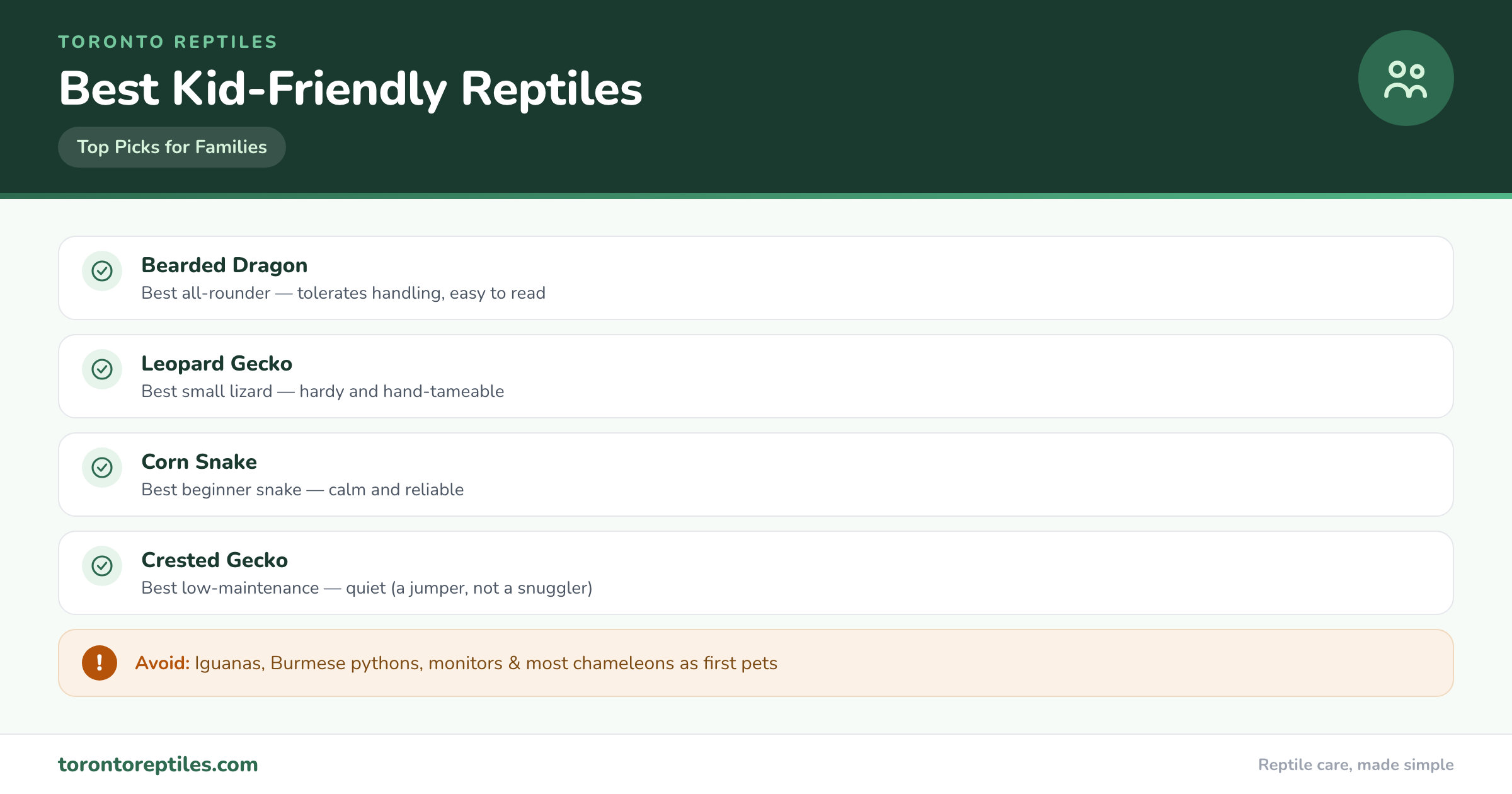
- Bearded dragons and leopard geckos are the two best first reptiles for most families — they tolerate handling, eat readily, and have well-documented care.
- Corn snakes are the best beginner snake; ball pythons are popular but stress more easily and can go on long food strikes.
- Crested geckos are excellent for kids who want something quiet and low-maintenance, but they are jumpers, not snugglers.
- Avoid green iguanas, Burmese pythons, monitors, and most chameleons as first pets — they grow huge, are temperamental, or have specialized care needs that punish small mistakes.
- Match the lifespan to the family: a leopard gecko is 15–20 years, a corn snake 15–20, a bearded dragon 8–12, and a tortoise 50+. That last one is a multi-generational commitment.
What “Kid-Friendly” Actually Means
The phrase gets thrown around a lot, but it covers four very different things, and the right reptile for your family is the one that scores well on all four.
1. Tolerates handling
Some reptiles genuinely don’t mind being held. Bearded dragons will sit on a shoulder for an hour. Corn snakes wrap loosely around a wrist and explore. Other species — most chameleons, anoles, day geckos — get visibly stressed by handling and shouldn’t be picked up except for husbandry reasons. If your child wants to actually interact with the animal, that narrows the list a lot.
2. Forgiving of small mistakes
Kids forget things. They forget to mist, they spill water, they leave the heat lamp off overnight once. A good first reptile has a wide tolerance window for short-term mistakes. Leopard geckos are famous for this — they store fat in their tails and can ride out a missed feeding without drama. Crested geckos eat a powdered diet that mixes with water and lasts in the bowl for two days. A chameleon, by contrast, can decline rapidly if humidity drops for 24 hours.
3. Sized for a normal home
A green iguana is a 5-foot lizard. A Burmese python is a 12-foot snake. Both are sometimes sold as cute babies in pet stores. Neither belongs in a family home. The species we recommend top out at about 4 feet for snakes and 24 inches for lizards, with enclosures that fit on a standard piece of furniture.
4. Lifespan that fits your plan
This is the one most families don’t think about. A bearded dragon lives 8–12 years — roughly the length of childhood. A corn snake or leopard gecko can run 15–20 years, meaning your child will likely take them to college. A Russian tortoise can live 50+ years, and you, the parent, are the one signing up for that. There is no wrong answer, but it is a real question.
The Best Reptiles for Families, Ranked
Here is the short list. We have hands-on experience with every species below — from years of keeping bearded dragons, boas, tortoises, and tarantulas ourselves, and from the animals that come through our rehoming.
| Species | Adult Size | Lifespan | Handleability | Setup Cost (CAD) | Best For |
|---|---|---|---|---|---|
| Bearded dragon | 18–24 in | 8–12 yrs | Excellent | $500–$800 | Families wanting interaction |
| Leopard gecko | 7–10 in | 15–20 yrs | Very good | $300–$500 | Younger kids, lower maintenance |
| Corn snake | 3–5 ft | 15–20 yrs | Excellent | $300–$500 | Best first snake |
| Crested gecko | 4–6 in | 15–20 yrs | Fair (jumpers) | $250–$400 | Quiet observers, no heating drama |
| Ball python | 3–5 ft | 20–30 yrs | Good when calm | $400–$700 | Older kids, patient owners |
| Russian tortoise | 6–10 in | 50+ yrs | Good | $700–$1,200 | Multi-generational commitment |
Bearded dragon — the top pick
If we had to recommend one reptile for the average family, it would be a bearded dragon. They are alert, active during the day (so you actually see them), genuinely seem to recognize their keepers, and tolerate handling better than almost any other lizard. Lia, our own beardie, will fall asleep on a shoulder mid-visit. Their setup is more involved than a leopard gecko’s because they need strong UVB and a hot basking spot, but the effort pays off in personality. We cover the full setup in our complete bearded dragon care guide for beginners.
Leopard gecko — the most forgiving
The leopard gecko is the reptile that the entire hobby points new keepers toward, and for good reason. They eat insects, drink from a bowl, don’t need UVB if their diet is supplemented properly (though modern keepers do offer it), and tolerate beginner mistakes better than any other lizard we’ve worked with. They are nocturnal, so they’re most active in the evening — convenient timing for a kid coming home from school.
Corn snake — the best beginner snake
Most kids who want a snake initially ask for a ball python. We usually steer them toward a corn snake instead. Corns are more active, eat more reliably, tolerate handling more consistently, and rarely refuse food — which is the single biggest source of anxiety for new ball python keepers. They come in dozens of color morphs and stay manageable at adult size.
Crested gecko — the low-effort option
Cresties are the rarest combination in reptile-keeping: small, beautiful, and require almost no specialized equipment. They eat a powdered “crested gecko diet” mixed with water — no insects required if you don’t want them — and live happily at room temperature in most Canadian homes. The trade-off is that they are fast, jumpy, and shed their tails if grabbed roughly, so they suit calm, observant kids more than enthusiastic huggers.
Ball python — popular, but not always the right call
Ball pythons are everywhere in pet stores, and they are genuinely great snakes — once you understand them. The reason we don’t put them at the top of the list is that they are notorious food strikers (some refuse meals for months), they are mostly nocturnal so daytime interaction is limited, and they are sensitive to humidity and temperature drops. For an older child or teenager who has researched the species, they are a fantastic pet. For a 7-year-old expecting daily action, a corn snake will be a happier match.
Russian tortoise — only with eyes wide open
Tortoises are wonderful, but the lifespan is the catch. A Russian tortoise can outlive your child’s college years and still be slowly walking around eating dandelion greens 50 years from now. The Russian tortoise we kept was calm, durable, and great with kids — but a tortoise stays in the family long after the kids who grew up with it have moved out. If the family is comfortable with that, tortoises offer the kind of long-arc relationship few pets can match.
Species to Skip as a First Pet
Just as important as the “yes” list is the “no” list. The following are sometimes sold as kid-friendly and almost never are.
- Green iguana — grows to 5+ feet, often becomes territorial and aggressive at sexual maturity. The most surrendered pet reptile there is.
- Burmese python, reticulated python, boa constrictor — large constrictors that outgrow most homes and pose real safety considerations.
- Savannah monitor, Nile monitor, tegu — large, intelligent, demanding lizards. Wonderful for experienced keepers, wrong for a first pet.
- Veiled and panther chameleons — fragile, stress easily, hate handling, and can decline overnight from small husbandry mistakes.
- Anoles, basilisks, water dragons — display animals, not handling animals. Kids who want to interact will be disappointed.
- Wild-caught anything — captive-bred only. Wild-caught reptiles arrive stressed, often with parasites, and frequently don’t thrive.
An Age-by-Age Guide
Two kids of different ages handle the same reptile very differently. Here’s how we’d match species to kids.
| Child’s Age | Recommended Species | Why |
|---|---|---|
| 4–6 | None as primary keeper — let them meet reptiles through friends, local herp societies, or reptile zoos first. | Too young to handle responsibly; small fingers, fragile animals |
| 7–9 | Leopard gecko, crested gecko (with parent help) | Small, hardy, simple diets a child can manage with supervision |
| 10–12 | Bearded dragon, corn snake, leopard gecko | Old enough for handling and feeding routines; benefits from interaction |
| 13–17 | Any of the above plus ball python, Russian tortoise (family commitment) | Capable of full husbandry; ready for longer-lived species |
For families with kids under 7, we usually suggest holding off on the long-term commitment. Low-stakes exposure first — friends’ pets, a local herpetological society meetup, a reptile zoo — tells you quickly whether your child is actually a reptile kid or a cat-and-dog kid in a phase.
Setting Realistic Expectations
The setup costs more than the animal
This is the most common surprise. A leopard gecko costs $50–$100. The enclosure, heating, lighting, hides, substrate, and feeding supplies cost $300–$500. The same is true for every species on this list. Budget for the setup, not the animal.
Daily time is small. Setup time is not.
Once an enclosure is properly built, daily maintenance is genuinely minimal — 5 to 10 minutes for spot-cleaning, water changes, and a feeding check. The work is in the initial setup and in the weekly deep-clean.
“My kid will do all the care”
This is true 60% of the time and false 40% of the time, in our experience. Plan for the realistic case where you, the parent, become the backup keeper. If you genuinely won’t enjoy that role, pick a species you also want to live with.
Frequently Asked Questions
What is the easiest reptile for a child to take care of?
A leopard gecko is widely considered the easiest. It’s small, hardy, eats a simple insect diet, and tolerates a forgiving range of temperature and humidity conditions.
Are reptiles safe for kids?
Yes, with two important caveats. First, all reptiles can carry salmonella, so handwashing after handling is non-negotiable. Second, kids under 5 should not be primary keepers, and very young children should always handle reptiles with adult supervision.
What’s the friendliest reptile pet?
Bearded dragons. They actively engage with their keepers, recognize routines, and tolerate handling for long stretches. They’re the closest a reptile gets to “behaving like” a small mammal.
Should we get one reptile or two?
One. Most reptiles on this list are solitary species that don’t benefit from companionship and can become aggressive when housed together. Cohabitation is for advanced keepers and specific species.
How long until we know if our kid will stick with it?
Plan for a six-month honeymoon, after which the daily novelty fades and the routine takes over. Kids who are still excited at the six-month mark will usually stay engaged for years. This is part of why we recommend low-stakes exposure first for younger kids — it’s a fast way to see whether the interest holds.
Are reptiles a good pet if someone in the house has allergies?
Often, yes. Reptiles don’t shed dander the way mammals do, which is one of the most common reasons families come to us looking for a pet. The exception is feeder insects — a small number of people develop sensitivities to cricket or roach proteins over time.
Try Before You Buy
If you’re still on the fence, meet a few species in person before deciding. When you adopt through us, meeting the animal first is part of the process — and we’ll tell you honestly whether the species suits your family, including when the answer is “not this one.”
This guide describes general husbandry practices and isn’t a substitute for veterinary care — the Association of Reptile and Amphibian Veterinarians maintains a directory of qualified exotics vets. Reptiles can carry Salmonella even when healthy, so follow Health Canada’s handling and hand-washing guidance, especially around young children.