

Reptile diet is the single biggest factor in long-term health, and it is the area where new keepers make the most expensive mistakes. Most “my reptile won’t eat” threads on Reddit trace back to a feeder that was the wrong size, offered at the wrong frequency, dusted with the wrong supplement, or presented at a temperature where the animal physically couldn’t digest it. None of that is intuitive — humans don’t think about whether the room is warm enough for our stomach to work — but for a reptile, every meal is a thermal calculation. Get the four rules below right and most feeding problems never happen — they’re the same rules we apply to every animal that comes through our rehoming intake.
TL;DR: Match the feeder to the predator class, dust insects with calcium correctly (D3 every other feeding for juveniles), never offer prey wider than the space between the animal’s eyes, and get basking heat right before food — digestion is thermal.
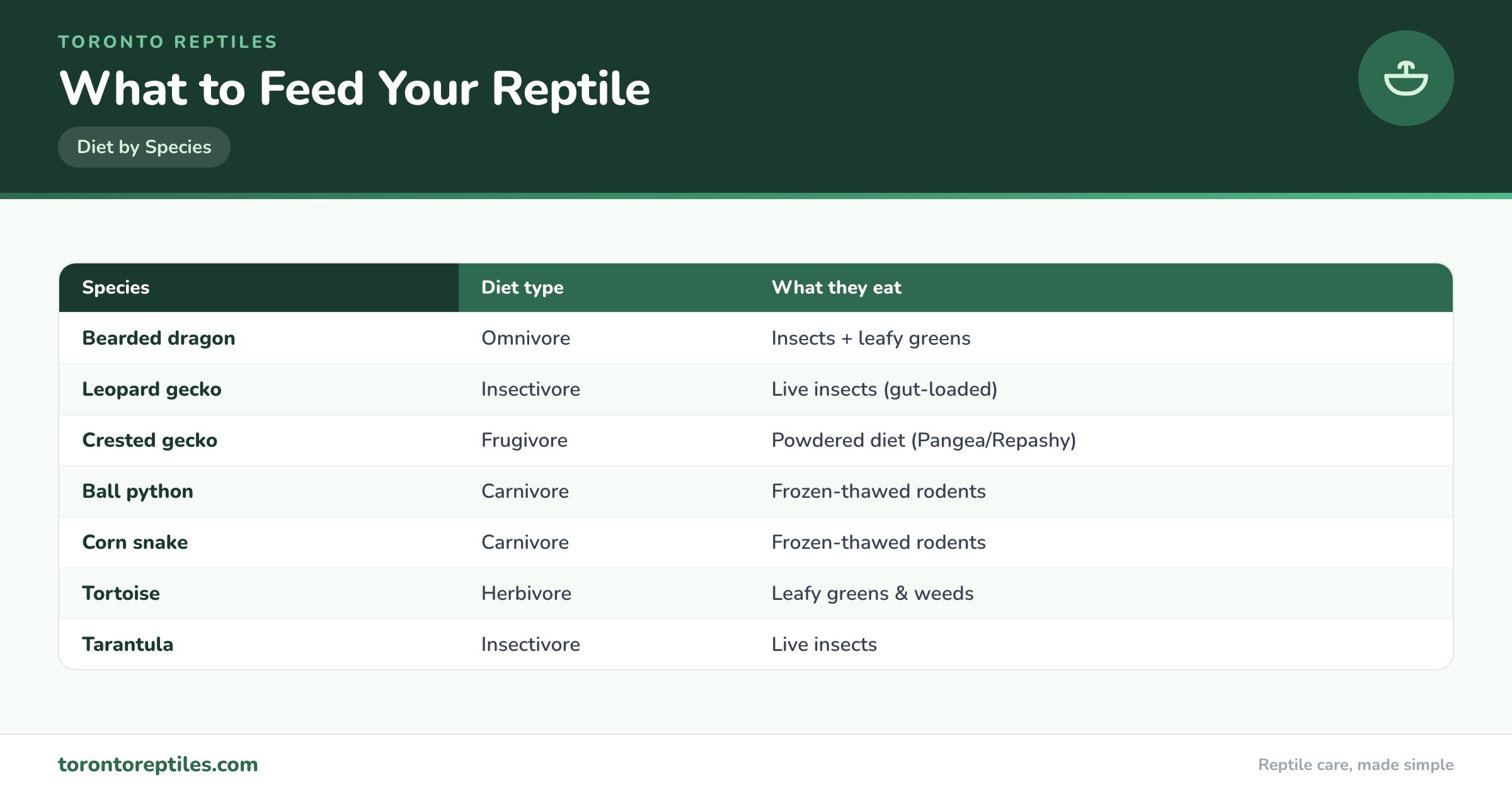
This guide covers what to feed the species we work with most often at Toronto Reptiles: bearded dragons, leopard and crested geckos, ball pythons, corn snakes, tortoises, and tarantulas. We’ll cover age-based feeding schedules, the live-feeder vs. salad split for omnivores, supplementation routines, and the husbandry conditions that have to be right before you offer food at all. We’ll also cover the tempting-but-wrong choices — iceberg lettuce, mealworms as a staple, wild-caught insects, “cricket food” that is mostly oats — that quietly cause problems for months before they cause a vet visit.
A note before we get into the species tables: a reptile in good condition will sometimes refuse food during a shed, during brumation, after being moved, or during a temperature swing. That is normal. A reptile that refuses food for weeks while everything else is set correctly is a vet visit, not a food-swap problem.
Key Takeaways
- Match the feeder to the predator class. Insectivores (geckos, juvenile beardies), omnivores (adult beardies), carnivores (snakes, monitors), herbivores (tortoises) — they don’t share staples and one can’t substitute for another.
- Dust insects with calcium + D3 every other feeding for juveniles. Plain calcium (no D3) on the off-feedings, and a multivitamin once a week.
- Prey size never wider than the space between the animal’s eyes. Larger means impaction risk. Smaller is always fine.
- Heat first, then food. A digesting reptile needs basking temperatures in the correct range. Cold reptiles regurgitate.
- Wild-caught insects are off-limits. Pesticide and parasite load is unpredictable, and the risk isn’t worth the convenience even from a “clean” backyard.
The Four Reptile Diet Categories
Before you can plan a feeding routine, you need to know which category your animal falls into. Most beginner husbandry mistakes come from treating, say, a tortoise like a bearded dragon, or a leopard gecko like a corn snake. Here is the quick map:
| Category | Examples | Staple Foods | Treats / Variety |
|---|---|---|---|
| Insectivore | Leopard gecko, crested gecko (partial), tarantula, juvenile bearded dragon | Crickets, dubia roaches, black soldier fly larvae | Hornworms, silkworms, the occasional waxworm |
| Omnivore | Adult bearded dragon, blue-tongued skink | Leafy greens, dubia roaches, squash, bell peppers | Berries, hornworms, occasional egg |
| Carnivore | Ball python, corn snake, boa, monitor | Appropriately-sized frozen-thawed rodents | Variety of rodent species (ASF, rat, mouse) by life stage |
| Herbivore | Russian tortoise, sulcata, Hermann’s tortoise | Grasses, weeds, leafy greens, edible flowers | Squash, cactus pads, the rare berry |
The animals who live with us — Lia the bearded dragon and our two boas — fall into different categories themselves, which is why a quick look at our animals is also a lesson in how varied reptile diets get.
Bearded Dragons
Bearded dragons are the species most often fed wrong, because their needs change dramatically with age. Hatchlings are roughly 80% insects and 20% greens. Adults flip that — a six-month-old that is still being offered crickets at every meal is on a fast track to fatty liver disease.
Feeding schedule by age
- 0–3 months: Insects 2–3 times daily, greens always available. Calcium + D3 every feeding.
- 3–6 months: Insects once daily, greens always available. Calcium + D3 every other feeding.
- 6–12 months: Insects every other day, greens daily. Calcium + D3 every other feeding, multivitamin once weekly.
- 12+ months: Insects 2–3 times per week, greens daily. Calcium + D3 twice weekly, multivitamin once weekly.
Good staple greens are collard, mustard, dandelion, escarole, endive, and turnip greens. Spinach and kale are fine in rotation but bind calcium, so they shouldn’t make up the bulk of the salad. Iceberg lettuce has effectively zero nutritional value and shouldn’t appear at all. Our deeper coverage of this is in our bearded dragon care guide for beginners, which includes a sample weekly menu.
Leopard and Crested Geckos
Leopard geckos are obligate insectivores. They cannot — should not — eat fruit, salad, or pellets marketed as “gecko diet.” Their staple is appropriately-sized crickets and dubia roaches, with hornworms and silkworms used for variety. Mealworms can be offered occasionally, but their hard exoskeleton makes them a poor staple, and superworms are best left for adults.
Crested geckos are the easier of the two from a feeding standpoint because Pangea, Repashy, and Black Panther make complete meal-replacement powders that mix with water and meet 100% of nutritional needs on their own. Most pet crested geckos are fed exclusively on these powders for their entire lives, with the occasional dubia or hornworm offered as enrichment. The single biggest crested gecko mistake is making the powder too thick — it should be the consistency of ketchup, not yogurt.
| Species | Staple | Frequency | Supplement |
|---|---|---|---|
| Leopard gecko (juvenile) | Crickets, dubia | Daily | Calcium + D3 every feeding |
| Leopard gecko (adult) | Crickets, dubia | Every 2–3 days | Calcium + D3 twice weekly |
| Crested gecko (any age) | Pangea / Repashy / BPZ powder | Every other day, fresh | Built into the powder |
Ball Pythons and Corn Snakes
Snakes are the simplest reptile diet to plan and the most common one to overcomplicate. The rule is one prey item, appropriately sized, every 7–14 days for adults. Hatchlings eat more often (every 5–7 days) because they’re growing.
Use frozen-thawed rodents, not live. Live prey can bite and injure a snake that isn’t immediately hungry, and frozen-thawed is also more humane and far easier to source. Thaw in the fridge overnight, then warm to ~100°F (38°C) in a sealed bag in warm water before offering. Never microwave.
Picking the right prey size
The standard rule is that the prey item should be roughly the same diameter as the widest part of the snake. A small leftover lump for 24–48 hours after eating is normal; a visible bulge that lasts a week is too big. Ball pythons in particular are notorious for refusing food during the cooler months — this is normal seasonal behaviour, not a husbandry failure, as long as the snake isn’t visibly losing weight.
Tortoises
Tortoises are pure herbivores, and their diet is the one most often ruined by good intentions. The common mistake is feeding “salad” — supermarket greens, cucumbers, tomatoes, fruit. Russian tortoises and most other commonly-kept species evolved to eat tough, fibrous, low-protein, high-calcium plants: grasses, dandelions, plantain, hibiscus leaves, mulberry leaves, prickly pear pads.
Fruit is a once-a-month treat at most. High-protein foods (legumes, peas, animal protein of any kind) cause shell pyramiding and kidney damage in tortoises that survives well into adulthood. The Tortoise Table (an open online database) is the best resource for “is this plant safe?” lookups.
- Daily staples: Spring/summer weeds (dandelion, plantain, clover), collards, escarole, endive
- 2–3x weekly: Squash, bell pepper, cactus pad
- Monthly or less: Berries, melon, banana
- Never: Iceberg lettuce, dog/cat food, dairy, peas, beans, citrus
Tarantulas
Tarantulas are the lowest-maintenance feeders in the entire hobby. An adult tarantula eats one or two appropriately-sized crickets or dubia roaches per week, and many adults voluntarily fast for weeks before a moult. Slings (juveniles) eat more often — once or twice a week of pre-killed pinhead crickets or fruit fly cultures — and grow quickly.
The two rules that matter: never offer a feeder larger than the tarantula’s body, and never leave an uneaten feeder in the enclosure. A roaming cricket can chew on a moulting tarantula and kill it. Remove anything not eaten within an hour.
Supplementation
Captive insects are nutritionally incomplete. They lack the calcium, vitamins, and trace minerals reptiles get from the broader food web in the wild. The fix is two parts: gut-loading and dusting.
Gut-loading is feeding feeders nutritious food for at least 24 hours before offering them. Use a quality commercial gut-load (Repashy Bug Burger is the standard) or fresh greens, squash, and carrot — not the “cricket food” pellets sold at most pet stores, which are mostly oats and have no real nutritional value.
Dusting is coating the feeder in supplement powder right before offering. A small container, a pinch of powder, drop the feeder in, shake gently, and serve. The standard rotation for a juvenile insectivore is calcium with D3 at one feeding, plain calcium at the next, and a multivitamin (Repashy Calcium Plus, Arcadia EarthPro-A, or similar) once a week.
Common Feeding Mistakes
- Feeding mealworms as a staple. Their chitin shell is hard to digest and their calcium-to-phosphorus ratio is bad. Use them as the occasional snack, not the daily meal.
- Feeding before the basking spot is up to temperature. If the basking surface isn’t at the species’ target (105–110°F for beardies, 90–95°F for leos, 88–92°F for ball pythons), the animal can’t digest. Always check temps before feeding.
- Hand-feeding aggressively. Hand-feeding the occasional treat is fine for socialization, but feeding every meal by hand teaches the animal to associate hands with food, and that’s how new keepers get bitten.
- Free-roaming feeders. Crickets left loose in an enclosure will chew on a sleeping or shedding reptile. Use a feeding dish or tongs.
- Wild-caught insects. Even from a backyard with no pesticides, insects can carry parasites, bacteria, and herbicide residue from neighbouring properties.
Frequently Asked Questions
How long can a reptile go without eating?
Healthy adult ball pythons routinely fast for 2–4 months in winter. Adult bearded dragons may slow down significantly during brumation. Leopard geckos can skip a few feedings during a shed. The rule of thumb: as long as weight is stable and the rest of the animal looks healthy, a fast that lasts weeks is usually fine. Sustained weight loss is the warning sign — not the missed meal.
Can I feed my reptile food from my fridge?
For omnivores and herbivores, plain raw vegetables and the leafy greens listed above are fine. For carnivores, no — human meat scraps don’t have the bone, organ, and connective-tissue balance a whole prey item provides. Don’t feed cooked meat, dairy, processed food, or anything seasoned.
Do I need live insects, or are dried/canned okay?
Live insects are strongly preferred for insectivores because the movement triggers the feeding response. Freeze-dried and canned insects are missing moisture and are often refused. They can work as an emergency backup but shouldn’t be the default.
My reptile won’t eat. What do I do?
Run through the checklist before reaching for vet advice: are temps correct, is the animal in shed, has the enclosure been moved or recently set up, is the prey size appropriate, is the prey too cold, is there a stressor (a new pet, construction noise, a tank that’s too bright)? Fix the obvious things first. If everything is right and the fast lasts more than 4–6 weeks for a juvenile or longer than 2–3 months for an adult, book an exotics vet.
How much should I feed?
For juveniles, “as much as they’ll eat in 10–15 minutes” is the working rule. For adults, follow the species-specific frequencies above and watch body condition. A bearded dragon should have a flat-but-rounded belly, not a sunken or distended one. A snake should have visible muscle definition along the spine but no kink in the body shape.
Are there any “complete” diets that don’t need supplementation?
For crested geckos, yes — Pangea, Repashy, and Black Panther Zoological make complete diets that meet 100% of nutritional needs. For every other commonly kept species, no. Pellet diets exist for bearded dragons and tortoises, but they should be rotated with fresh food, not used exclusively.
Can I breed my own feeders?
Dubia roach colonies are the most common DIY feeder source. They’re quiet, low-smell, can’t escape into a Toronto apartment to establish (they need 75°F+ to breed), and produce a steady supply once established. A starter colony of 100 mixed-stage adults will support a single bearded dragon within 4–6 months.
Want to See What Healthy, Well-Fed Reptiles Look Like?
The animals in our care eat the diets above, every week, year-round — and every adoptable listing spells out exactly what that animal eats and how often, so there’s no guesswork on day one. If you’re considering a reptile of your own, see who’s looking for a home.
This guide describes general husbandry practices and isn’t a substitute for veterinary care — the Association of Reptile and Amphibian Veterinarians maintains a directory of qualified exotics vets. Reptiles can carry Salmonella even when healthy, so follow Health Canada’s handling and hand-washing guidance, especially around young children.