

Bearded dragons are one of the most popular reptile pets in the world — and one of the most consistently mis-cared-for. They’re advertised as beginner-friendly, which they are compared to some species, but they require specific heat, lighting, diet, and enclosure conditions that people routinely get wrong. A beardie kept correctly lives 10–15 years, bonds with its keeper, and is genuinely one of the most interactive reptile companions available. Kept incorrectly, they die of preventable disease in 2–3 years — and care that turns out harder than advertised is a big part of why bearded dragons so often need rehoming.
TL;DR: A bearded dragon needs a 40-gallon-minimum enclosure, non-negotiable UVB, a hot basking spot, and a diet that flips from ~70% insects (juveniles) to ~70% vegetables (adults). Done right, that’s a 10–15-year companion; done wrong, preventable disease in 2–3.
This guide is the complete starting point — written from the perspective of people who keep them every day. Our own bearded dragon, Lia, is one of the friendliest animals we’ve worked with, and this guide reflects the daily care she gets. You can meet her and the rest of the animals who live with us.
Everything here applies to keeping a bearded dragon at home, whether you’re considering adopting one or you’ve just brought one home and want to do it right.
Key Takeaways
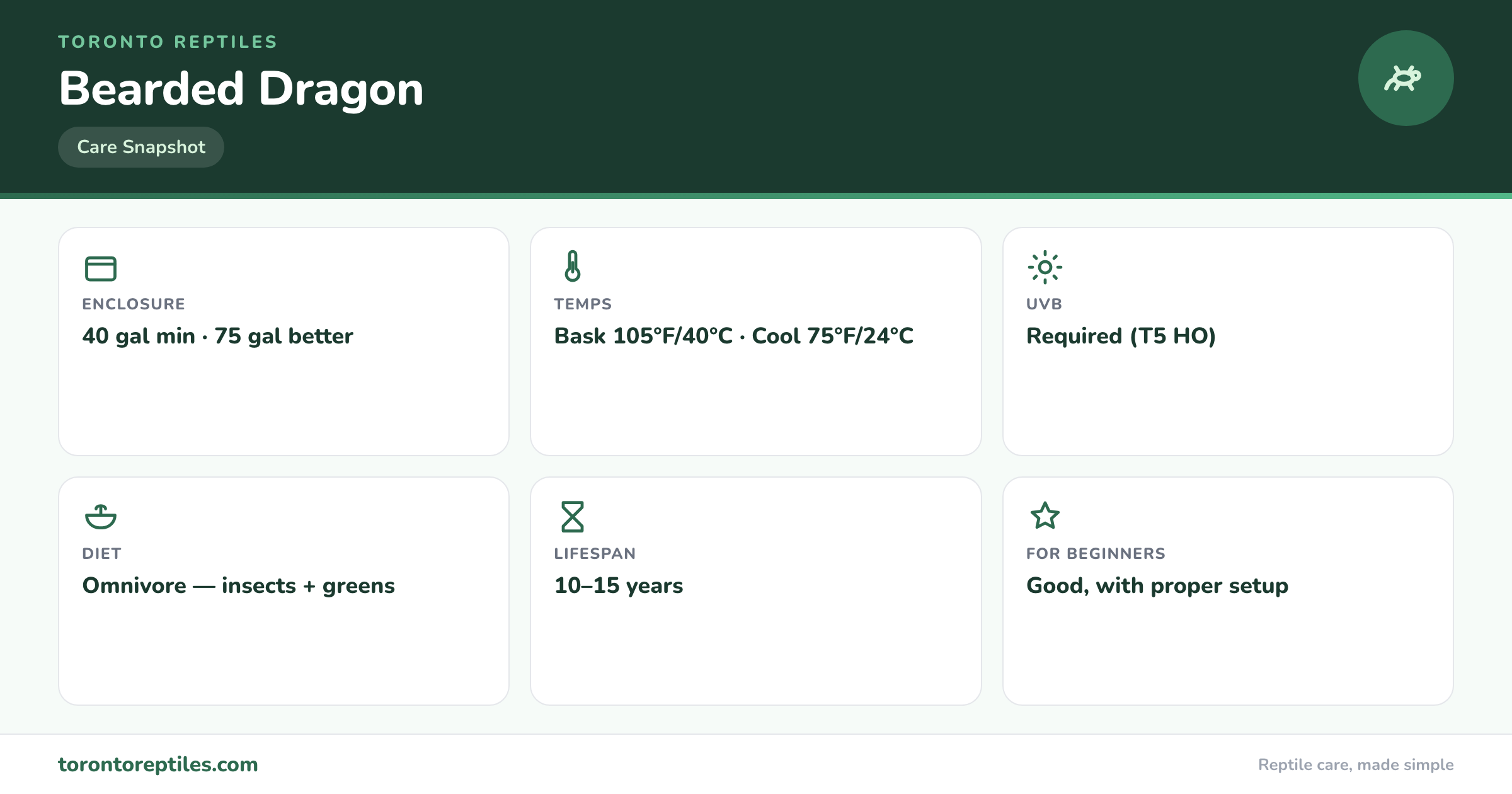
- Bearded dragons need a 40-gallon minimum enclosure (adult) with UVB lighting, a hot basking spot (105°F / 40°C), and a cool zone (75°F / 24°C).
- Diet changes with age: juveniles eat 70% insects, 30% vegetables; adults flip to 70% vegetables, 30% insects.
- UVB lighting is non-negotiable — without it, they develop metabolic bone disease and die prematurely.
- Total cost of proper setup in Canada: $600–$1,200 up-front, then roughly $40–$80/month in food and utilities.
- Expected lifespan: 10–15 years in good conditions. This is a long-term commitment.
Choosing a Healthy Bearded Dragon
The quality of your starting animal makes the first year of ownership much easier. Look for:
- Clear, alert eyes — no discharge, no crust
- Rounded body — not bony at the hips or tail base
- All limbs and toes intact — missing digits often indicate past health issues
- Smooth mouth, no lumps or discoloration around the jaw
- Active response to stimulus — a healthy beardie should watch you and respond when approached
- Clean vent (the rear opening) — no caked waste or redness
Ask the seller how old the animal is, what it’s been eating, how often it’s being handled, and whether it’s been vet-checked. Responsible breeders and rescue organizations should provide this without hesitation. Avoid animals sold at flea markets, kiosks, or non-specialty stores — these animals are frequently wild-caught or poorly raised.
Enclosure Setup
Size
The bare minimum for an adult is a 40-gallon breeder tank (36″ × 18″ × 16″). A 75-gallon (48″ × 18″ × 21″) is much better. Juveniles can live in smaller setups temporarily but will need the full-size enclosure within 6–9 months. Don’t buy a small tank thinking you’ll upgrade later — buy the big one from the start. Our bearded dragon tank size guide breaks down the full spectrum of enclosure options — glass vs. PVC, dimensions, and what actually matters for adult beardies.
Substrate
Three reasonable choices, and several bad ones.
- Reptile carpet — safe, washable, boring. Fine for juveniles.
- Tile (ceramic or slate) — safe, easy to clean, attractive. Our top recommendation for sterile setups.
- Bioactive substrate — mix of play sand, topsoil, and clay. More natural behaviour, better welfare. See our bioactive terrarium guide for the full approach.
- AVOID: loose calcium sand (major impaction risk), walnut shell (same), aspen or pine shavings (respiratory irritation)
Hides and furniture
Every enclosure needs:
- A cool-side hide — cork log, ceramic hide, or DIY cave
- A basking platform — a rock or branch elevated into the heat zone
- Climbing branches — bearded dragons love vertical space
- A shallow water dish (many beardies ignore it, but offer one)
- At least one visual barrier so they can retreat from view when stressed
Temperature and Lighting — The Part Everyone Messes Up
This is where most bearded dragon deaths come from. Get this right and 90% of health problems never happen.
Heat gradient
| Zone | Daytime temperature | Nighttime temperature |
|---|---|---|
| Basking spot (hot) | 105–110°F / 40–43°C | N/A (bulb off) |
| Warm side ambient | 85–95°F / 29–35°C | 65–75°F / 18–24°C |
| Cool side ambient | 75–85°F / 24–29°C | 65–72°F / 18–22°C |
Use a halogen or incandescent basking bulb (not ceramic or night bulbs) in a dome fixture directly above the basking spot. Measure the actual surface temperature with an infrared thermometer — not the air temperature. Your bulb wattage will depend on your enclosure size; start with 100W and adjust.
UVB lighting
Critical. Bearded dragons need UVB to synthesize vitamin D3, which lets them absorb calcium. Without it, they develop metabolic bone disease — curved limbs, weak jaw, eventual paralysis and death. Specifically:
- Use a T5 HO fluorescent bulb (Arcadia 12% or Zoo Med ReptiSun 10.0 are the gold standards)
- Mount the bulb inside a reflector for proper output
- Distance from basking spot: 10–12 inches
- Replace every 6–12 months (UVB output degrades even when the bulb still lights up)
- Bulb length should be roughly 2/3 of the enclosure length
UVB is not optional. It is not replaceable with vitamin supplements. It is not achievable through a window (glass filters UVB). Budget for proper UVB lighting or don’t get a bearded dragon.
Diet by Age
Hatchlings (0–4 months)
70% insects, 30% vegetables. Feed insects 2–3 times daily, as much as they’ll eat in 10 minutes. This is the only life stage where they need frequent insect feeding.
Juveniles (4–12 months)
60% insects, 40% vegetables. One insect meal daily, unlimited fresh greens available at all times.
Sub-adults (12–18 months)
Transitioning to adult diet. 50% insects, 50% vegetables. Insects every other day.
Adults (18 months+)
30% insects, 70% vegetables. Insects 2–3 times per week. Fresh greens daily. Obesity is the most common adult health problem — do not overfeed insects. For the full breakdown of safe and unsafe foods, exact ratios by life stage, and supplement schedule, our complete bearded dragon diet guide covers each phase in depth.
Good insects
- Dubia roaches (gold standard — high protein, low fat)
- Crickets (widely available but jumpy)
- Black soldier fly larvae (calcium-rich)
- Silkworms (treats, expensive)
- Hornworms (treats, high water content — great for dehydrated animals)
Good vegetables
- Collard greens (staple)
- Mustard greens (staple)
- Turnip greens (staple)
- Dandelion greens (staple, free from a clean yard)
- Butternut squash, bell peppers, green beans (regulars)
- Blueberries, raspberries (treats, once a week)
Foods to avoid
- Lettuce (any variety) — nutritionally empty, causes diarrhea
- Spinach & kale — bind calcium, cause metabolic issues
- Avocado, rhubarb, onion, citrus — toxic
- Mealworms as a staple — high fat, low nutrition, chitin impaction risk
- Firefly/glowing insects — toxic, can be fatal in small quantities
Supplements
- Calcium with D3: dust insects 3–4 times per week for juveniles, 1–2 times per week for adults
- Multivitamin: dust insects once per week for all ages
Handling and Socialization
Bearded dragons are unusually tolerant of handling for a reptile. A well-socialized beardie will recognize its keeper, respond to voice, and often prefer being on the keeper’s lap or shoulder to being in the enclosure.
New animal (first 2 weeks)
Minimal handling. Let them settle into the new enclosure. Offer food, clean waste, observe quietly. Stress-induced refusal to eat is common in the first week — don’t panic.
After 2 weeks
Begin short handling sessions: 5–10 minutes at first, approaching slowly from the side (not from above — that mimics predators). Support the body fully; never pick up by the tail.
Long term
Most bearded dragons enjoy 15–30 minutes of daily handling. Signs they’re relaxed: relaxed body posture, closed eyes, no beard darkening. Signs they want to go back: puffing the beard, trying to climb away, repeated attempts to hide.
Common Health Issues
Metabolic bone disease (MBD)
The #1 killer of pet beardies. Caused by inadequate UVB or calcium. Symptoms: tremors, soft or deformed jaw, bent limbs, weakness. Prevention is everything — MBD can’t be fully reversed. Treatment requires a reptile vet immediately.
Impaction
Blockage from eating too-large insects or loose substrate. Symptoms: refusal to poop, lethargy, visible abdominal lump. Small cases can resolve with warm baths; severe cases need vet intervention.
Respiratory infection
From cool temperatures or wrong humidity. Symptoms: mucus around mouth or nose, wheezing, gaping. Correct the temperature immediately and see a vet.
Parasites
Common in newly-acquired animals. Annual fecal exams at a reptile vet are worth the cost.
Brumation
Not an illness — bearded dragons enter a state of reduced activity (like hibernation) in winter. They’ll eat less, sleep more, maybe stay in a hide for weeks. This is normal and healthy in adults. Don’t force-feed a brumating beardie unless they’re losing significant weight.
Cost Breakdown (Canadian, 2026)
| Item | One-time cost (CAD) |
|---|---|
| Enclosure (40-gallon breeder) | $150–$300 |
| UVB bulb + fixture | $80–$150 |
| Basking bulb + fixture | $40–$80 |
| Substrate & decor | $60–$150 |
| Thermometers (infrared + digital) | $30–$60 |
| Hides, branches, water dish | $50–$120 |
| Initial vet check | $80–$150 |
| Bearded dragon (juvenile, from breeder) | $100–$250 |
| Total up-front | $590–$1,260 |
Ongoing monthly costs: $40–$80 for live insects, greens, supplements, and electricity for lighting. Budget another $200–$500 annually for bulb replacements and vet checks.
Is a Bearded Dragon Right for You?
Be honest with yourself. Bearded dragons are a 10–15 year commitment. They require daily attention, weekly insect shopping, and thousand-dollar emergency vet bills occasionally. They are also among the most rewarding reptile pets — affectionate by reptile standards, easy to handle, and genuinely charming in their own quiet way.
If you\’re still weighing species, our comparison of the most beginner-friendly reptiles walks through how bearded dragons stack up against ball pythons, corn snakes, and the geckos.
Frequently Asked Questions
How often should I feed my bearded dragon?
Juveniles: insects 2–3 times daily, greens always available. Adults: insects 2–3 times per week, greens daily. Amount varies by individual — most adults eat 10–20 insects per feeding.
Can I bathe my bearded dragon?
Yes. A weekly 15-minute soak in lukewarm water (just above belly depth) helps with hydration and shedding. Many beardies enjoy bath time. Never leave them unsupervised in water.
Are bearded dragons good pets for kids?
Yes, with adult supervision. They’re among the most tolerant reptiles for handling, and kids who learn to care for one properly gain real life skills. For a full age-by-age breakdown of which reptiles work best with children, our guide to the best kid-friendly reptiles covers the full spectrum. Just remember the adult is ultimately responsible for the animal’s care.
Can two bearded dragons live together?
No. Bearded dragons are solitary and territorial. Housing them together — even two females — leads to stress, missing toes, and fight injuries. One beardie per enclosure.
How long do bearded dragons live?
Properly cared for, 10–15 years. Some individuals live 18+ years — see our full bearded dragon lifespan guide for what affects longevity. Poorly cared for, they rarely reach 5.
Do bearded dragons bite?
Rarely, and usually only if stressed, cornered, or mistaken for food. A beardie bite feels like a firm pinch — not dangerous. Bites are almost always preventable with good handling technique.
Do I need a reptile vet?
Yes. Not all vets treat reptiles. Find a qualified exotics vet before you need one — searching in an emergency is much harder. The Ontario Veterinary College and several GTA-area clinics offer reptile services.
Meet Lia — Our Bearded Dragon
Lia is the bearded dragon who lives with us — a bright, handleable six-year-old and the friendliest beardie we’ve worked with. Seeing an adult in person before committing is one of the best ways to decide whether this is the right reptile for you, and when bearded dragons come through our rehoming, meeting the animal first is always part of the process.
This guide describes general husbandry practices and isn’t a substitute for veterinary care — the Association of Reptile and Amphibian Veterinarians maintains a directory of qualified exotics vets. Reptiles can carry Salmonella even when healthy, so follow Health Canada’s handling and hand-washing guidance, especially around young children.