
Leopard geckos are arguably the most beginner-friendly lizards in the hobby, and there’s a good reason they’ve become the “starter reptile” of choice across North America. They’re hardy, hand-tameable, don’t need UVB lighting in most setups, and have the kind of slow, deliberate temperament that makes them ideal for first-time keepers — including kids who are learning patience and gentle handling. Before buying one, it’s worth checking the reptiles currently looking for new homes with us — long-lived pets like these are exactly the ones that end up needing a second chance.
TL;DR: Give a leopard gecko a 20-gallon-long tank minimum (30+ is better), belly heat from below, calcium with D3, and a varied diet of gut-loaded insects. No UVB needed in most setups — and 15–20 years of slow, gentle company.
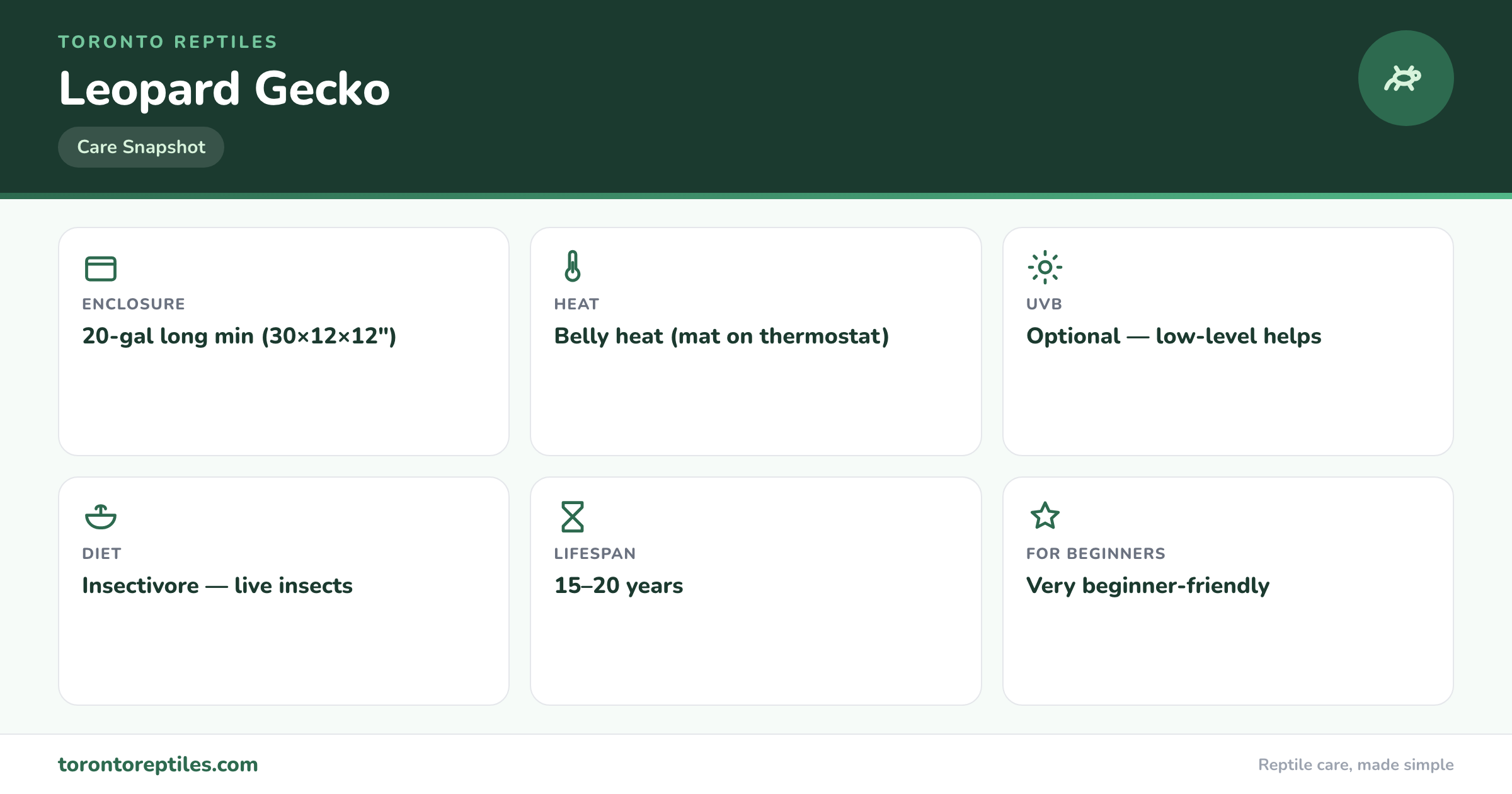
That said, “beginner-friendly” doesn’t mean low-effort. A leopard gecko done right can live 15 to 20 years, and the difference between a thriving gecko and a stressed, unhealthy one usually comes down to a handful of small details: floor heat versus overhead heat, the right substrate, calcium with D3, and the discipline to not feed mealworms exclusively.
This guide pulls together what we’ve learned from years of keeping leopard geckos at Toronto Reptiles — including the questions Toronto families ask us most often, and the mistakes we see new owners make in their first six months.
Key Takeaways
- Leopard geckos are nocturnal ground-dwellers — they need belly heat from below (a heat mat or DHP), not a basking lamp from above
- A 20-gallon long tank is the minimum for one adult; bigger is better, and 30+ gallons is ideal
- Calcium with D3 supplementation is non-negotiable for captive leopard geckos and prevents metabolic bone disease
- Avoid loose substrate for hatchlings and juveniles — paper towels or non-adhesive shelf liner are safest
- Diet variety matters — crickets, dubia roaches, black soldier fly larvae, and the occasional mealworm or waxworm
Are Leopard Geckos a Good Fit for Your Family?
Before you buy the tank, take an honest look at whether a leopard gecko matches your household. They are quiet (no barking, no chirping, no nighttime noise beyond the occasional hunting rustle), low-allergen (no fur, no dander, an excellent option for kids with allergies), long-lived (15–20 years means a leopard gecko bought for a 7-year-old will outlast their high school graduation), active in the evening (perfect timing for a school-age kid who wants a pet to interact with after dinner), and tolerant of careful handling (most leopard geckos can be tamed to sit calmly on a hand within a few weeks).
They are not, however, a “watch them swim around all day” pet like a fish. For most of the daylight hours, your gecko will be tucked in a hide. If your child wants something they can stare at constantly, look elsewhere — or spend time with a few different species in person before committing to one. The animals who live with us are a good picture of how differently reptile species behave.
Setting Up the Enclosure
Tank Size
For a single adult leopard gecko, we recommend a 20-gallon long (30″ × 12″ × 12″) as an absolute minimum. A 30 or 36-gallon enclosure is better, particularly if you want to include the kind of naturalistic decor that lets the gecko climb low branches and explore. Glass terrariums with a screen top work well; PVC enclosures retain heat better and are worth the investment if you live somewhere drafty. For a complete breakdown of heating placement, substrate depth, hide positioning, and the humid hide setup that prevents retained sheds, our leopard gecko tank setup guide walks through every element in detail.
Avoid the small kits sold at big box pet stores. A 10-gallon “starter kit” is too small for an adult gecko, and you’ll be replacing it within months. For a full walkthrough of heating layout, substrate choices, hide placement, and decor, see our dedicated leopard gecko tank setup guide.
Heat: Belly First, Then Air
This is where most first-time keepers go wrong. Leopard geckos are crepuscular ground-dwellers from rocky desert grasslands. In the wild, they bask on warm rocks at dusk — their heat comes from below, conducted into the belly while they digest. In captivity, that translates to:
- An under-tank heat mat covering one-third of the tank’s footprint, controlled by a thermostat
- Surface temperature on the warm side: 88–92°F (31–33°C)
- Cool side: 70–75°F (21–24°C)
- Nighttime drop is fine — temps can fall to 65°F (18°C) at night
A thermostat is mandatory. An unregulated heat mat will run hot enough to burn a gecko’s belly through the glass. The Inkbird ITC-308 is the gold standard at the budget end, and the Herpstat is what we use on display tanks.
If your room is consistently below 70°F (21°C), add a low-wattage ceramic heat emitter or DHP (deep heat projector) on a thermostat for ambient warmth. Avoid white-light basking bulbs — they disrupt the gecko’s day-night cycle.
Lighting and UVB
For decades, hobbyists kept leopard geckos with no UVB at all, and most lived long lives. Recent research suggests low-level UVB (a 5.0 or 7% T5 bulb) does benefit them, particularly with calcium metabolism. We run a 7% T5 over our display geckos for 10–12 hours a day, with plenty of hides so the gecko can opt out.
If you choose to skip UVB, dust feeders with calcium + D3 at most feedings. If you provide UVB, you can use plain calcium more often (D3 from sunlight equivalent reduces over-supplementation risk).
Substrate
For hatchlings and juveniles under 6 months: paper towels or reptile carpet only. Loose substrates like sand, calci-sand, or walnut shell can cause impaction in young geckos that strike at and ingest them while hunting.
For healthy adults, options include paper towels (cheap, easy to spot-clean, looks clinical), non-adhesive shelf liner (good middle ground), or a bioactive desert mix — 50/50 organic topsoil and play sand, plus leaf litter and isopods, the most naturalistic and the lowest maintenance long-term, but requires more setup knowledge. If you’re interested in going bioactive, our primer on building a closed terrarium ecosystem covers the underlying principles, though it’s written for tropical setups (the same concepts apply with desert substrate).
Hides and Furniture
A leopard gecko needs a minimum of three hides: a warm dry hide on the heat mat side, a cool dry hide on the cool side, and a humid hide (moss-filled) on the warm side for shedding. Each hide should be just big enough that the gecko can fit snugly inside — geckos feel safe with their backs and sides touching the walls of the hide, not in a cavernous space.
Add low climbing branches, cork bark slabs, and live or fake plants for visual barriers. A water dish that’s wide and shallow (not deep — they don’t swim) goes on the cool side.
Diet and Feeding
Staple Feeders
Leopard geckos are insectivores, full stop. No fruit, no vegetables, no commercial gecko diet. The staple feeders in rotation should include crickets (classic choice, but they’re loud and escape constantly), dubia roaches (cleaner, quieter, easier to gut-load, and our top pick), black soldier fly larvae or BSFL (naturally high in calcium, great as a regular feeder), and mealworms (fine as part of rotation, but not as a staple due to their low calcium-to-phosphorus ratio). For a deeper look at insect nutrition, gut-loading, and variety by life stage, our complete reptile diet guide covers feeder selection across all common species.
Treat Feeders (sparingly)
- Waxworms — high fat, addictive; offer 1–2 max per week
- Hornworms — hydrating treat for adults
- Superworms — for adult geckos only, never juveniles
Feeding Schedule by Age
| Age | Frequency | Quantity |
|---|---|---|
| Hatchling (0–3 months) | Daily | 5–7 small crickets/roaches |
| Juvenile (3–12 months) | Every other day | 6–8 medium feeders |
| Adult (12+ months) | 2–3x per week | 6–10 medium-large feeders |
A useful rule of thumb: feeders should be no longer than the width between the gecko’s eyes. Anything bigger risks impaction. For the full breakdown of feeder types, gut-loading protocols, and feeding schedules by life stage, our complete leopard gecko diet guide covers everything in one place.
Supplementation
This is the single most important thing to get right. Dust feeders with calcium plus D3 at every feeding for hatchlings and juveniles, every other feeding for adults if no UVB is provided. If you’re running UVB, alternate D3 calcium with plain calcium. Add a multivitamin (Repashy Calcium Plus or Reptivite) once per week, and keep a small dish of plain calcium in the enclosure for self-supplementation in adults.
Water
Fresh water in a shallow dish at all times. Most geckos don’t drink visibly — they get most of their hydration from prey and from licking condensation in their humid hide.
Handling and Taming
The first two weeks after bringing a leopard gecko home should be hands-off. Let them eat and acclimate. After that, start with brief sessions:
- Open the tank and place your hand flat inside, palm up, for 30–60 seconds. Don’t grab.
- After a few days of this, gently nudge them onto your hand from the side (never from above — birds attack from above).
- Lift slowly and keep them low over a soft surface in case they jump.
- Sessions of 5–10 minutes max for the first month.
A stressed gecko will drop its tail. A regenerated tail never grows back the same — it’ll be stubbier and a different texture. Treat the original tail like a precious thing.
Signs of a relaxed gecko in your hand: slow blinking, walking calmly, licking nose (taste-mapping), eating from tongs while on your hand. Signs to put them back: squirming, chirping or barking, tail wagging or shaking, dark stress coloration.
Common Health Issues
Metabolic Bone Disease (MBD)
The single most common preventable issue. Caused by calcium and vitamin D3 deficiency. Symptoms include rubbery jaw, twisted limbs, and difficulty walking. Prevention: proper supplementation. Treatment: vet-prescribed calcium injections; severe cases are rarely fully recoverable. Our guide to common reptile health problems covers MBD and other conditions to watch for.
Impaction
Caused by ingesting loose substrate or feeders too large for the gecko. Symptoms: loss of appetite, no defecation for 7+ days, lethargy, visible swelling. Prevention: appropriate substrate and feeder size. Treatment: warm baths, mineral oil, and a vet visit if no improvement in 48 hours.
Stuck Shed
Caused by inadequate humidity in the humid hide. Stuck shed on toes can cut off circulation and cause toes to fall off. Prevention: keep moss in the humid hide damp at all times. Treatment: gentle warm-water soak and careful removal with a damp cotton swab.
Cryptosporidiosis
A parasitic infection that’s nearly always fatal. Symptoms: chronic weight loss despite eating, “stick tail” (tail thinning to skin and bone). Prevention: buy from a reputable breeder and quarantine new geckos for 90 days before introducing to existing collection. Treatment: there is none — only supportive care. A reptile vet should be on speed dial before you bring the gecko home, not after the symptoms appear.
Cost Breakdown
Here’s a realistic Toronto-area budget for the first year of a leopard gecko:
| Item | One-Time | Annual |
|---|---|---|
| Tank (30-gal) | $120–180 | — |
| Heat mat + thermostat | $80–100 | — |
| Hides (3) | $30–50 | — |
| Substrate | $20 | $40 |
| UVB bulb + fixture | $80–100 | $40 (bulb replacement) |
| Water/food dishes | $15 | — |
| Decor (branches, plants) | $40–80 | — |
| The gecko itself | $50–300 | — |
| Vet (annual checkup) | — | $150–250 |
| Feeders + supplements | — | $300–400 |
| Total | $435–845 | $530–730 |
Skip the cheap pet store starter kits — you’ll spend more replacing each piece individually within the first year. Buy the proper equipment once and you’re set for a decade.
Frequently Asked Questions
Are leopard geckos legal to own in Ontario?
Yes. There’s no provincial restriction on leopard geckos. Some municipalities have exotic animal bylaws (Toronto is mostly permissive for non-venomous reptiles), so check your city’s bylaw if you’re outside the GTA core.
Can two leopard geckos live together?
Two females can sometimes cohabitate in a large enclosure (40+ gallons), but it requires careful observation. Two males will fight. A male-female pair will breed constantly, which is hard on the female. We recommend solo housing for first-time keepers.
How often do leopard geckos shed?
Hatchlings shed every 1–2 weeks, juveniles every 3–4 weeks, adults monthly to every other month. They eat the shed (yes, all of it) for the calcium.
Do leopard geckos bite?
Rarely. A bite from an adult feels like a sharp pinch — they don’t have the jaw strength to break skin in most cases. If you’re bitten, it’s almost always because the gecko mistook your finger for food or felt cornered.
Can my child handle the gecko?
Supervised, after the gecko has been tamed, kids 6+ generally do fine. We recommend kids handle over a low surface (couch, bed, lap on the floor) so a startled jump doesn’t end in a fall. Wash hands before and after every handling session.
Do leopard geckos need a friend?
No. They are solitary animals in the wild and don’t experience loneliness the way mammals do. A second gecko is for your benefit, not theirs.
What’s the best age to start with a leopard gecko?
Look for a juvenile that’s at least 8–10 weeks old, eating consistently, and has all original toes and tail. Hatchlings sold at very small sizes are often more delicate than they look.
Adopting Instead of Buying
If your family is on the fence, meeting a settled adult gecko tells you more than any care sheet. When leopard geckos come through our rehoming, the listing covers temperament, feeding history, and the setup they’re used to — and meeting the animal before committing is always part of the process.
Or if you’re already past the “should we?” stage and want to build the perfect bioactive enclosure for your new gecko, start with our reptile enclosure setup guide for a step-by-step build walkthrough.
This guide describes general husbandry practices and isn’t a substitute for veterinary care — the Association of Reptile and Amphibian Veterinarians maintains a directory of qualified exotics vets. Reptiles can carry Salmonella even when healthy, so follow Health Canada’s handling and hand-washing guidance, especially around young children.