
A closed terrarium is a sealed glass container holding a tiny, self-sustaining ecosystem: substrate, plants, moisture, and air — completely sealed off from the outside. Once you build it correctly and close the lid, it will quietly recycle its own water, feed its own plants, and live, in some documented cases, for decades without being opened. No animal required — though if watching a sealed jar thrive gets you curious about live keeping, see who’s waiting for a home.
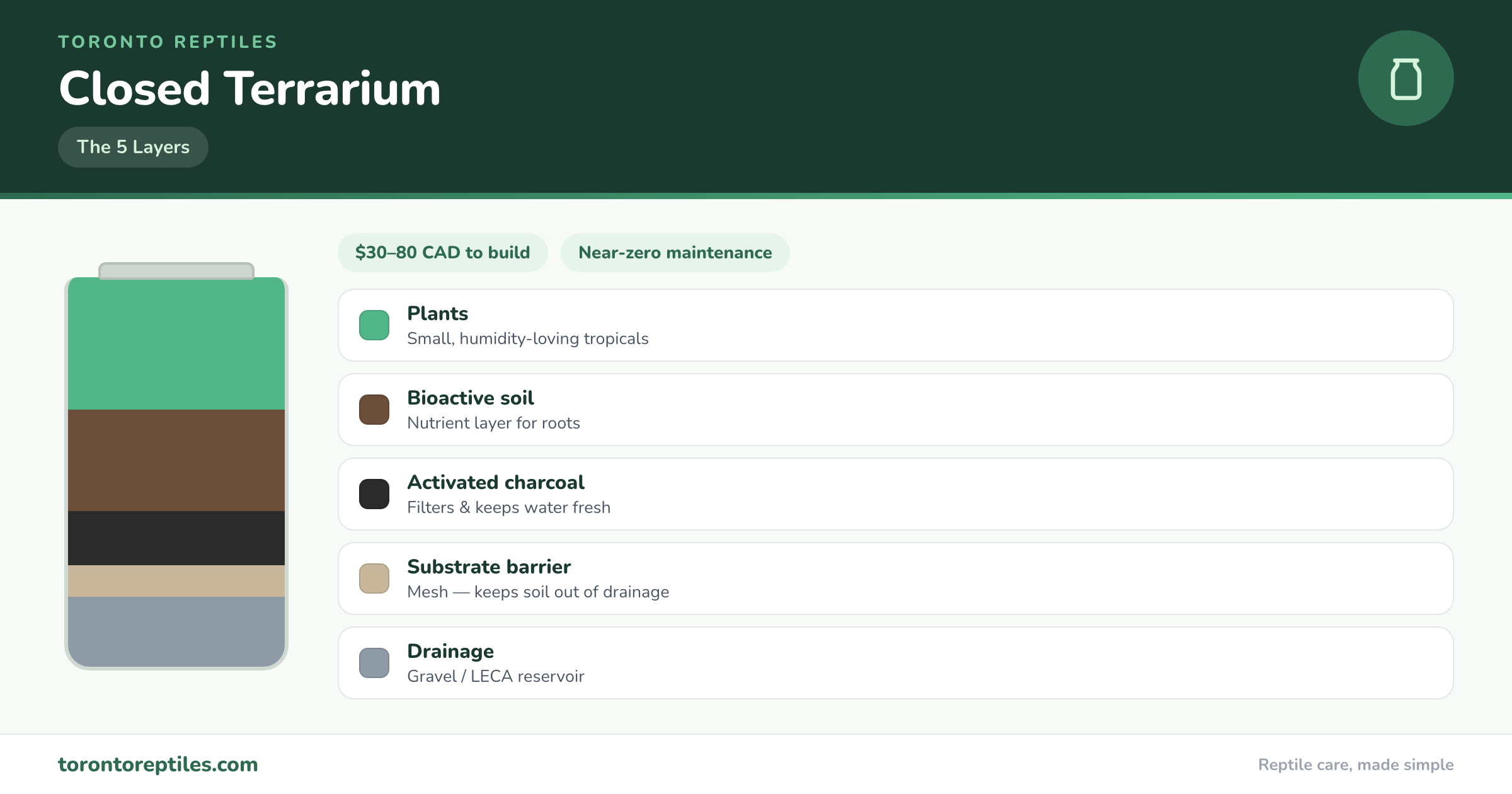
TL;DR: A closed terrarium is a sealed jar ecosystem: drainage → mesh barrier → activated charcoal → bioactive soil → small humidity-loving plants. Built right, it recycles its own water and can run for months or years untouched.
The most famous example is David Latimer’s bottle garden in the UK, which he planted in 1960, sealed in 1972, and has watered exactly once in over 50 years. The plants inside are still alive. That’s not a freak accident — it’s how closed ecosystems are supposed to work when the layers are right.
This guide covers every piece of building one: what a closed terrarium actually is, the water cycle happening inside, the exact supplies you need, the best plants (ferns, mosses, fittonia, and a few surprising options), the step-by-step build, and what to do when something goes wrong. It’s one of the easiest living systems you can make, and it’s just plants and rainforest science in a jar — no isopods, no animals, no daily chores.
Key Takeaways
- A closed terrarium is a sealed glass container that forms a self-contained ecosystem — the water inside recycles through condensation indefinitely.
- They require almost no maintenance — well-built closed terrariums can go months or years between waterings.
- The essential layers are: drainage → substrate barrier → activated charcoal → bioactive soil → plants.
- Best plants are small, humidity-loving, slow-growing tropicals — ferns, mosses, fittonia, pilea, and selaginella.
- Total cost for a first build: $30–$80 CAD depending on vessel size and plant selection.
What Is a Closed Terrarium?
A closed terrarium is a fully sealed glass container — typically a jar, bottle, or purpose-built terrarium with a lid — containing a living community of tropical plants growing in layered substrate. Once sealed, the system operates on internally recycled water and sunlight.
The term “closed” is the key distinction. An open terrarium exposes its contents to room air, loses humidity continuously, and needs regular watering. A closed terrarium keeps its humidity inside the vessel, where it cycles through evaporation and condensation on a daily loop — essentially manufacturing its own rain.
That single difference flips the maintenance profile. Open terrariums are roughly as much work as houseplants. Closed terrariums, done right, are one of the lowest-effort living things you can own. A sealed vessel on a shelf with morning indirect light will maintain itself for years.
The Science: How a Closed Terrarium Stays Alive
There are three cycles running simultaneously inside a closed terrarium, and all three have to be balanced for the system to stabilize.
The water cycle
Plants release moisture through their leaves (transpiration). That moisture hits the glass, cools, and condenses into droplets. The droplets run down the glass and drip back into the substrate, where plant roots absorb them. Then the cycle repeats. A healthy closed terrarium will show condensation on the glass in the mornings — that’s the cycle working.
The carbon cycle
During daylight, plants perform photosynthesis: they take in CO₂, release O₂. At night, they respire: take in O₂, release CO₂. In a closed system these gases stay in rough equilibrium because the plants themselves produce both. Combined with the substrate’s microbial activity (which also respires), the carbon balance is self-regulating.
The nutrient cycle
When leaves die and fall, they’re broken down by microbes and fungi living in the substrate. The decomposition releases nitrogen, phosphorus, and other nutrients back into the soil, where the living plants absorb them. This is why you don’t fertilize a closed terrarium — the dead plant matter is the fertilizer.
All three cycles depend on one thing: the seal. Open the lid for more than brief inspections and you break the water cycle, which cascades into the others.
What You Need to Build One
The vessel
Any glass container with a tight-fitting lid works. The classic options:
- Large mason jars (1–2 quart)
- Apothecary jars with glass lids
- Purpose-built terrariums from plant shops or reptile suppliers
- Repurposed bottles (cold-brew, kombucha, vintage glass) — just make sure you can plant through the opening
- Geometric glass planters (closed variants only)
Larger vessels are more forgiving — more substrate buffers humidity swings, and there’s room for plant roots to spread. A 2-quart or larger jar is easier for beginners than a tiny bottle.
The materials
| Layer | Material | Why it’s needed |
|---|---|---|
| Drainage layer | LECA clay balls or small pebbles | Holds excess water below the substrate so roots don’t rot |
| Substrate barrier | Mesh screen or landscape fabric | Prevents soil from settling into the drainage layer |
| Filter layer | Activated charcoal (aquarium-grade) | Filters the water as it cycles; prevents anaerobic odors |
| Growing substrate | Sphagnum + coconut fiber + organic soil | The living substrate that supports plants and microbes |
| Decorative top | Moss, small stones, or bark (optional) | Aesthetics plus moisture retention |
| Plants | Small humidity-loving tropicals | The living engine of the ecosystem |
Total cost
A basic first build in Canada, sourcing from garden centres and aquarium stores, runs $30–$50. A nicer vessel with curated plant selections brings it to $60–$80. This is genuinely one of the cheapest living ecosystems you can own. For the complete materials list with exact quantities and sourcing notes, see our DIY terrarium kit guide.
Best Plants for a Closed Terrarium
The key plant traits for closed terrariums: they tolerate or thrive in high humidity, stay small (or can be pruned to stay small), grow slowly, and don’t mind low to medium indirect light. These are the workhorses. We cover plant selection in much more depth in our complete guide to the best plants for a closed terrarium.
Foundation plants (pick 2–4)
- Fittonia (nerve plant) — compact, colourful pink, white, or red veins. The terrarium classic.
- Pilea cadierei (aluminum plant) — small, metallic silver markings, very tolerant
- Peperomia (small varieties like P. prostrata or P. rotundifolia) — trailing, succulent-ish, extremely low maintenance
- Baby tears (Soleirolia soleirolii) — dense, tiny-leaved ground cover
- Button fern (Pellaea rotundifolia) — small fern, round leaflets, hardy
- Rabbit’s foot fern (Davallia) — fuzzy rhizomes, visually striking
Moss layer (highly recommended)
- Sheet moss — flat mat, covers substrate and holds moisture
- Cushion moss — domed, sculptural, long-lived
- Java moss — fast-growing, fills gaps
- Reindeer moss (preserved, not live) — aesthetic only, doesn’t grow
Accent plants (use sparingly, 1 per vessel)
- Selaginella (spikemoss) — fern-like, dense, humidity-dependent
- Tiny orchid species (Pleurothallis, miniature Masdevallia) — for advanced builders
- Creeping fig (Ficus pumila) — fast climber, keep pruned
- Small bromeliads (mini Neoregelia) — structural, colourful
What NOT to plant
- Succulents and cacti — they rot in closed humidity
- Full-size houseplants (pothos, monstera, philodendron) — they’ll outgrow the vessel in months
- Herbs, flowers, or edibles — wrong humidity profile
- Plants treated with systemic pesticides — check the label or buy from specialty growers
How to Make a Closed Terrarium: Step by Step
This is the same build sequence we’ve walked hundreds of first-time builders through. Total time for a first build is 45–60 minutes. For a deeper look at what each layer actually does and why the order matters, our guide to terrarium substrate layers covers the science behind every step.
- Clean your vessel thoroughly. Dish soap, warm water, rinse completely. Dry inside with a clean cloth or paper towel. No residue.
- Add the drainage layer. 1–2 inches of LECA or small pebbles. This layer should be visible through the glass — it’s part of the aesthetic.
- Add the substrate barrier. Cut a piece of mesh or landscape fabric to fit the container and lay it flat over the drainage layer.
- Add the charcoal layer. A half-inch of activated charcoal distributed across the mesh. This is the single most overlooked step by beginners and the difference between a terrarium that thrives and one that goes sour.
- Add the substrate. 1.5–3 inches (depending on vessel size) of growing substrate — a mix of sphagnum moss, coconut fiber, and organic potting soil. Slightly moisten it before adding.
- Shape the landscape. Create gentle slopes, depressions for plants, maybe a small hill. This is your chance to add visual interest before planting.
- Position hardscape. If you’re using stones, driftwood, or decorative elements, place them before planting. Press them firmly into the substrate.
- Plant. Start with larger plants in the back, smaller plants in the front. Use long tweezers for small jars. Gently firm the soil around each plant’s roots.
- Add the moss layer. Lay fresh moss across exposed substrate. Press it gently to make contact with the soil.
- Mist lightly. A few sprays to settle the substrate and wet the plants. Don’t soak — the substrate should be damp, not wet.
- Seal the vessel. Close the lid firmly. Place in a spot with bright but indirect light — never direct sun, which will cook the contents.
- Observe for the first 2 weeks. You should see condensation on the glass within 24 hours. If it’s excessive (can’t see through the glass), crack the lid for an hour. If there’s none after 3 days, add a few more mists and reseal.
Maintenance: What to Actually Do
This is the part that surprises people. A well-built closed terrarium needs astonishingly little.
Daily
Nothing.
Weekly
- Glance at it. Condensation should appear and clear throughout the day.
- Check light — if it’s getting direct sun, move it to a brighter-indirect spot.
Monthly
- Trim any plant that’s overgrowing (pothos-types especially).
- Remove dead or yellow leaves if you see them.
- Wipe the outside of the glass.
Rarely (every 6–12 months)
- Open the lid briefly if condensation is perpetually excessive — 1 hour is usually enough to rebalance.
- Add water only if the substrate looks visibly dry or the plants are wilting. Most closed terrariums won’t need watering for over a year.
If you find yourself tempted to “do something” to your closed terrarium — resist. The worst thing you can do is over-maintain a system that’s designed to run itself.
Troubleshooting Common Issues
Excessive condensation (can’t see through the glass)
Too much humidity. Crack the lid for 1–2 hours to release moisture, then reseal. If it happens consistently, your substrate is too wet — leave the lid off overnight to dry it out slightly.
No condensation at all
Too dry, or the seal is broken. Add 5–10 mists of filtered water, reseal, and watch for condensation to return within 24 hours. If it doesn’t, check that your lid actually seals.
Mould growing on plants or soil
Too wet, poor airflow during the first few weeks, or a pre-mouldy piece of material. Remove the visibly mouldy portion with tweezers. Increase light slightly. Consider adding springtails — these tiny hexapods eat mould and are terrarium keepers’ best secret weapon. Available from most reptile and invertebrate suppliers.
Plants yellowing or dying
Most common causes: too much direct sun (cooking), too little light, or too wet substrate (root rot). Move out of direct sun, increase indirect light, or reduce moisture if the substrate is soaking.
Everything looks cloudy/milky
Bacterial bloom, usually from too much organic material decomposing at once. Open the lid for 24 hours, let the system dry slightly, reseal. It typically resolves within a week.
Plants outgrew the vessel
Time to prune. Or split the terrarium — remove a plant, root it elsewhere, and let the remaining plants fill in. You can also upgrade to a larger vessel and start fresh.
Closed vs. Open Terrarium: Which to Choose
| Factor | Closed terrarium | Open terrarium |
|---|---|---|
| Humidity | High (self-sustained) | Ambient room humidity |
| Watering frequency | Months to years | Every 1–2 weeks |
| Best plants | Tropical humidity-lovers (ferns, mosses, fittonia) | Succulents, cacti, air plants |
| Light needs | Bright indirect (no direct sun) | Bright to direct sun |
| Lifespan | Years to decades | 1–2 years typically before a rebuild |
| Maintenance effort | Very low | Moderate |
| Best for | Hands-off keepers, gift recipients, office desks | Active gardeners, succulent enthusiasts |
There’s no “better” option — they’re genuinely different systems. A closed terrarium is a living sculpture that runs itself; an open terrarium is a plant arrangement you tend like any houseplant. Closed ecosystems get most of the love in the hobby because they’re quietly magical — but open setups are the right call if you’re building with succulents, air plants, or cacti.
Can You Put Animals in a Closed Terrarium?
Yes — with the right species and the right setup. The most common option is to add a small clean-up crew of isopods and springtails, which turns a standard closed terrarium into a bioactive one. The invertebrates process any dead plant matter, keep mould in check, and make the system even more self-sustaining. It’s a small step up in complexity for a big step up in resilience.
For more detail, see our complete guide to isopod terrariums and our full guide to bioactive terrariums — which covers the same sealed-ecosystem principle but designed to house reptiles or amphibians.
What you should not put in a closed terrarium: any vertebrate (reptiles, amphibians, fish), because the oxygen level in a sealed vessel can’t sustain them long-term. Vertebrates need open or partially open setups with active airflow — see our bearded dragon care guide for an example of the kind of open enclosure those animals actually require.
Frequently Asked Questions
How long can a closed terrarium last without opening?
A well-built closed terrarium with the right plant selection and lighting can easily last 5–10 years without opening. The most famous documented example (David Latimer’s bottle garden) has gone over 50 years and is still alive.
Do closed terrariums need direct sunlight?
No — never direct sun. The glass magnifies heat and will cook everything inside within hours. Bright indirect light is ideal. A spot near but not directly in front of a north or east-facing window is usually perfect.
How do I know if my terrarium is healthy?
Three quick checks: (1) condensation forms and clears on the glass throughout the day, (2) plants stay green and alive, (3) no persistent mould blooms. If all three are true, it’s working.
Can I add fresh water to a closed terrarium?
Only if the substrate looks genuinely dry or plants are wilting. When you do, use filtered or distilled water (tap water often contains chlorine that damages sensitive terrarium plants) and add just a few sprays.
What’s the best size for a beginner?
A 2-quart (roughly 2-liter) mason jar or a small purpose-built glass terrarium. Big enough to hold 2–4 small plants and be forgiving of humidity swings, small enough to not overwhelm a first-time builder.
Can kids make closed terrariums?
Absolutely — they’re one of the most kid-friendly building projects. Kids 6 and up can do the full build with supervision; pre-measure the layers to keep it manageable.
Where can I buy a closed terrarium kit in Canada?
Ecostems, Jackson Carey, and Canadian Tire all carry variants. Or — honestly — build your own from a jar; it’s cheaper and the experience is better.
From a Jar to a Living-Room Ecosystem
The video tutorials and written guides get you 80% of the way. The last 20% — how the substrate feels, how much pressure to use around plant roots, when the moisture is right — only comes from doing it. Start with a small jar build before committing to a large vessel; the materials cost almost nothing and the lessons transfer directly.