

Tarantulas are, hands down, one of the most misunderstood pets in the hobby. Hollywood taught a generation of people that they jump, that they are venomous killers, and that owning one signals something sinister about your personality. The reality is almost the opposite — they are quiet, low-space, low-cost pets that go weeks between meals, require no lighting, and will spend most of their adult lives sitting in roughly the same spot. For anyone in a Toronto condo with no room for a dog, they are arguably the most realistic “exotic” pet there is. And if you’re past the beginner stage, we currently have a Brazilian salmon pink birdeater looking for an experienced home.
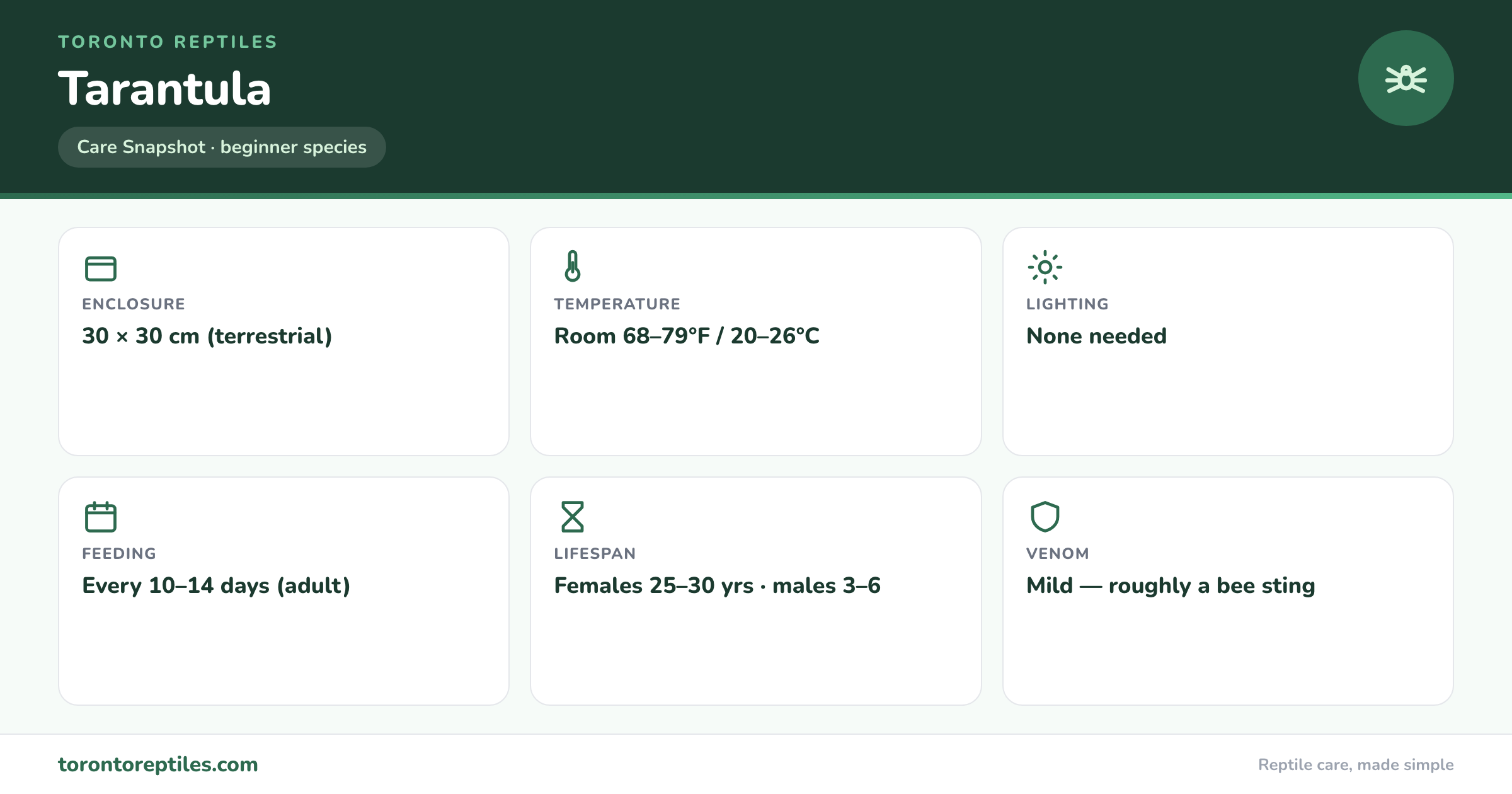
TL;DR: A beginner tarantula (Chilean rose, curly hair, Brazilian black) needs a 30 × 30 cm enclosure, room temperature, a water dish, and food every week or two. No lighting, no heat lamp, minimal handling — and females can live 25–30 years.
That said, “low maintenance” is not the same as “no maintenance.” Tarantulas have specific humidity, substrate, and feeding needs that vary sharply by species, and the single biggest mistake a new keeper makes is picking the wrong species on impulse. A pink-toe tarantula in the enclosure of a Chilean rose will die. A Brazilian wandering spider in the wrong hands can send a person to the ER. Species selection is everything.
At Toronto Reptiles, we’ve kept three very different tarantulas over the years — Shadow, Dusk, and Onyx — and this guide draws directly on what they taught us. If you are thinking about your first tarantula, start here before you buy anything.
Key Takeaways
- Most pet tarantulas are harmless to humans — New World species like the Chilean rose and curly hair have venom roughly equivalent to a bee sting and are the only species beginners should consider.
- Enclosure size is small on purpose. A 30 cm x 30 cm enclosure is plenty for a full-grown terrestrial tarantula. Bigger is not better — large enclosures make prey hard to find.
- No heat lamp, no UVB, no special lighting. Room temperature in a Canadian home (20–26 °C / 68–79 °F) is ideal for most common species.
- Handling is optional and mostly discouraged. A fall of even 15 cm can rupture a tarantula’s abdomen and kill it.
- They live a long time. Female Chilean rose tarantulas can live 25–30 years. Males live 3–6 years. Know which one you are buying.
Beginner-Friendly Species (and What to Avoid)
There are over 1,000 described tarantula species. Maybe a dozen are suitable for a first-time keeper. The dividing line runs along “New World versus Old World” — a distinction that matters enormously because it maps to temperament, venom potency, and defensive behaviour.
New World tarantulas (the Americas) have mild venom and a defensive strategy built around flicking urticating hairs from their abdomen. These hairs are irritating — they itch like fibreglass if they get on your skin — but the bite is medically insignificant for most people. This is where every beginner should start.
Old World tarantulas (Africa, Asia, Europe) have no urticating hairs and instead rely on potent venom and speed. A cobalt blue or Indian ornamental will not hesitate to bite, and the medical outcome is cramping, spasms, and hospital visits. These are expert-only species. Do not let any pet store talk you into one because “they look cool.”
| Species | Type | Adult Size | Temperament | Beginner-Friendly? |
|---|---|---|---|---|
| Chilean Rose (Grammostola rosea) | New World, terrestrial | 13–15 cm leg span | Docile, slow | Yes — top pick |
| Curly Hair (Tliltocatl albopilosus) | New World, terrestrial | 14–16 cm | Docile, eats well | Yes |
| Mexican Red Knee (Brachypelma hamorii) | New World, terrestrial | 13–16 cm | Calm, displays well | Yes |
| Pink-Toe (Avicularia avicularia) | New World, arboreal | 12–15 cm | Skittish but non-aggressive | Intermediate (humidity) |
| Brazilian Black (Grammostola pulchra) | New World, terrestrial | 15–18 cm | Extremely docile | Yes (if you can find one) |
| Cobalt Blue (Cyriopagopus lividus) | Old World, fossorial | 13–15 cm | Fast, defensive, potent venom | No — expert only |
| Indian Ornamental (Poecilotheria regalis) | Old World, arboreal | 18–22 cm | Fast, potent venom | No — expert only |
Meet our three
Shadow, our Chilean rose, was the calmest animal we’ve ever kept — the one we’d hand to first-time visitors who wanted to see a tarantula without being rushed. Dusk, a curly hair, had a much bigger appetite and a habit of webbing up her entire enclosure floor. Onyx, our Brazilian black, spent about 80% of her waking life posed on the same piece of cork bark and moved maybe once a month. All three were New World species, and all three are exactly the kind of tarantula we’d recommend to a beginner.
Enclosure Setup
Tarantula enclosures divide by lifestyle: terrestrial (ground-dwelling), arboreal (tree-dwelling), and fossorial (burrowing). Matching the enclosure to the lifestyle is more important than size.
Terrestrial setup (Chilean rose, curly hair, red knee, Brazilian black)
- Enclosure: 30 cm x 30 cm x 20 cm tall (12 in x 12 in x 8 in) — wider than tall
- Substrate: 8–10 cm of coconut fibre or topsoil/coco mix
- Hide: a half-log or cork bark piece for retreat
- Water dish: shallow, always full (discard the “sponge in a dish” advice from the 1990s — just a clean water dish)
- Temperature: 20–26 °C room temperature is fine
- Humidity: 60–70% for most species; lightly mist one corner of the substrate weekly
Arboreal setup (pink-toe)
- Enclosure: 20 cm x 20 cm x 35 cm tall — taller than wide
- Substrate: 5 cm for moisture buffer
- Structure: a tall piece of cork bark for web anchoring, plus silk or live plants
- Water dish: on the floor, always full
- Humidity: 70–80% with cross-ventilation, not closed-up muggy
Avoid tall terrestrial enclosures — a Chilean rose that climbs and falls even 20 cm onto hard decor can split her abdomen and die within hours. This is the single biggest enclosure mistake new keepers make.
Feeding
Tarantulas are ambush predators and need surprisingly little food. A healthy adult Chilean rose can eat two or three crickets per month and be perfectly nourished. Overfeeding is one of the more common welfare issues in the hobby — obese tarantulas have shorter lifespans and rupture more easily during moults. For a comparison of feeding requirements across popular first pets, our reptile and exotic pet diet guide covers prey types, frequency, and nutritional balance.
What to feed
- Crickets — the workhorse feeder; gut-load them 24 hours before feeding
- Dubia roaches — higher nutritional value, do not escape as easily, and quieter than crickets
- Mealworms — occasional variety; bury them if the tarantula refuses them on the surface
- Hornworms — a high-moisture treat; offer once a month at most
Feeding schedule
| Life Stage | Frequency | Prey Size |
|---|---|---|
| Sling (under 2 cm) | 2x per week | Pre-killed pinhead cricket or fruit fly |
| Juvenile (2–6 cm) | 1x per week | Small cricket or roach nymph |
| Sub-adult (6–10 cm) | Every 10–14 days | Medium cricket or roach |
| Adult (10+ cm) | Every 2–4 weeks | Large cricket, adult Dubia |
Always remove uneaten prey within 24 hours. A loose cricket can chew on a tarantula while she is moulting — an often-fatal outcome.
Moulting: The Most Important Thing to Understand
Tarantulas grow by shedding their exoskeleton — a process called moulting. This is when most husbandry accidents happen, and it is also the single behaviour new keepers panic about unnecessarily. We cover the full process in our complete guide to tarantula moulting — including the pre-moult signs that tell you a shed is coming, what to do (and never do) while the spider is vulnerable, and post-moult recovery and feeding timelines.
A tarantula preparing to moult usually stops eating — sometimes for weeks or months in adults. Her abdomen will darken and look “bald” as urticating hairs thin out. Eventually she will flip onto her back. This looks exactly like a dying spider. It is not. Do not touch her, do not move her, do not try to “help.” The moult can take anywhere from 20 minutes to 12 hours. Leave her alone.
After moulting, the new exoskeleton is soft and the fangs need about a week to harden. Do not feed for at least 7 days after a moult for juveniles, or 10–14 days for adults. Remove the moult — the empty exoskeleton — and keep it if you want to sex the spider (the shed contains easily examined reproductive structures).
To Handle or Not to Handle
This is the one topic where the hobby is split down the middle. Some keepers handle regularly. Others consider it unethical. Our position at Toronto Reptiles: minimise handling, and never handle a tarantula above waist height.
The reason is simple biology. Tarantulas do not “bond” with people. They tolerate. Meanwhile, a fall of even 15 cm onto a hard surface can rupture the abdomen fatally. Every time you hold a tarantula, you are accepting risk for an animal that gains nothing from the interaction. If you must handle — for enclosure changes, for example — do it at floor level, over soft substrate, and coax the spider onto a soft paintbrush or open hand rather than grabbing her.
Cost Breakdown
| Item | One-Time | Annual |
|---|---|---|
| Captive-bred tarantula (Chilean rose or curly hair) | $40–$120 | — |
| 30 cm acrylic terrestrial enclosure | $60–$90 | — |
| Substrate (coconut fibre, refreshed yearly) | $15 | $15 |
| Cork bark hide | $15 | — |
| Water dish, tongs, misting bottle | $20 | — |
| Feeder crickets or Dubia roaches | — | $60–$100 |
| Total | ~$175 | ~$90 |
Tarantulas are one of the cheapest long-term pets to keep, which is part of their appeal. A female Chilean rose over 30 years will cost less than a dog costs in its first year.
Health Red Flags
- Curled legs under the body — the “death curl” is a tarantula’s last posture and usually indicates dehydration or terminal illness
- Leaking fluid from the abdomen — almost always fatal; caused by falls or a failed moult
- Very skinny abdomen in an animal not about to moult — dehydration; check water access
- Refusing food for months without moult prep — usually normal for adult roses, but worth logging
- Mites crawling on the spider — usually from poor cricket husbandry; clean enclosure and replace substrate
Frequently Asked Questions
Are tarantulas legal to own in Ontario?
Yes, most commonly kept species are legal across Ontario and specifically in Toronto. Some Old World species may have municipal restrictions — if you branch out from beginner New World species, check your local bylaws first.
Do tarantulas recognize their owner?
Probably not in any way we would call “recognition.” Their vision is poor and they rely on vibration. That said, individual tarantulas absolutely have personalities — our Shadow was unflappable, Dusk a bulldozer, Onyx a statue — and these differences are real even if they do not map onto dog-style attachment.
Will my tarantula escape?
Only if the enclosure lid is not secured properly. Tarantulas are not escape-artists the way geckos are, but they will climb out of an open enclosure if the opportunity presents. Keep lids latched and cage mesh intact.
Can I keep two tarantulas together?
No. With exceedingly rare exceptions (a few social species from South America), cohabitation ends in one tarantula eating the other. Always one per enclosure.
What if I get bitten?
From a New World species like the ones covered here, a bite feels like a bee sting and resolves in hours. Wash the site, apply cold, monitor for allergic reaction (rare). From an Old World species, go to the ER. This is the main reason we recommend New World only for beginners.
What is the difference between a male and a female?
Hugely different lifespans. Male tarantulas mature at 3–5 years, then die within a year or two. Females live decades. If longevity matters to you, buy captive-bred and confirm sex before purchase.
Do tarantulas need humidity like a reptile enclosure?
Somewhat. Most beginner species do fine with a once-weekly light mist on one corner of the substrate plus a full water dish. Arboreals need more. You can learn a lot about substrate moisture and microfauna from our companion guide to keeping isopod terrariums — the same principles apply to tarantula substrates.
Ready for a Tarantula — or Rehoming One?
Reading about tarantulas is useful; spending time near one is what turns most people either on or off the idea of keeping one. If you’re an experienced keeper, our current adoptable animals sometimes include tarantulas. And if you have a tarantula you can no longer keep, we take in surrenders without judgment.
This guide describes general husbandry practices and isn’t a substitute for veterinary care — for health concerns, consult an exotics vet experienced with invertebrates.