
The crested gecko is the leopard gecko’s tropical cousin, and in the past 20 years it’s gone from “rediscovered species presumed extinct” to one of the most popular reptile pets in North America. There’s a reason: crested geckos don’t need supplemental heat in most homes, eat a complete powdered diet (no live insects required), live 15–20 years, and come in a range of colors and patterns from subtle olive to electric red and white. Thinking about one? Check who’s currently looking for a home with us first.
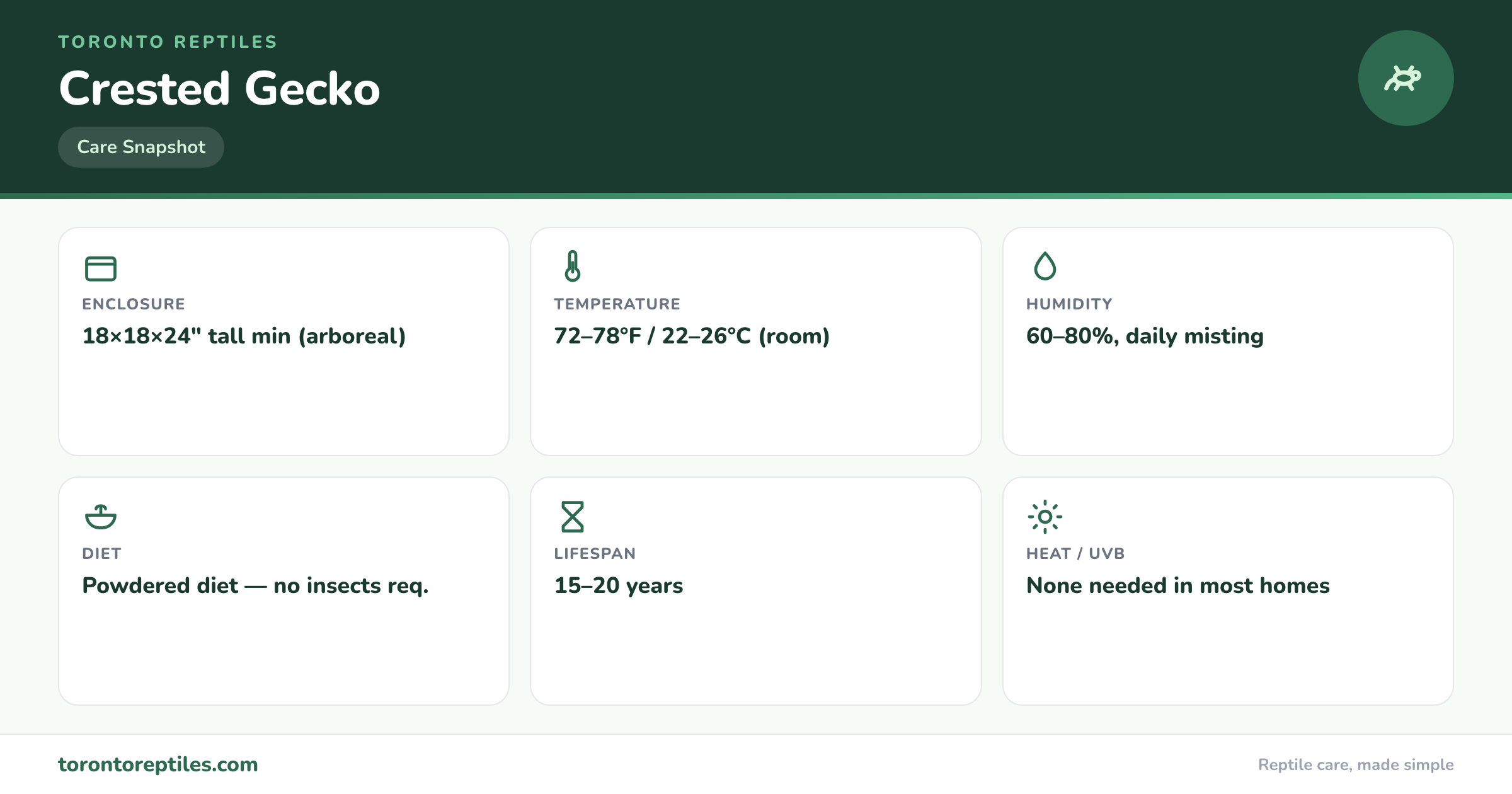
TL;DR: Crested geckos want a tall enclosure with climbing space, room temperature (72–78°F — extra heat can kill them), 60–80% humidity with daily misting, and a complete powdered diet. No live insects required — but the tail never grows back, so handle gently.
If you’ve decided you want a gecko but the cricket-keeping side of leopard gecko care is a dealbreaker, the crested gecko is your animal. They’re the rare reptile that fits comfortably into a busy household — even one where nobody loves the idea of a tub of dubia roaches in the kitchen.
This guide walks through what we’ve learned keeping crested geckos at Toronto Reptiles, with a focus on the questions Toronto-area families ask most before deciding between a crested gecko and another beginner species.
Key Takeaways
- Crested geckos are arboreal — they need a tall enclosure with vertical climbing space, not a long horizontal one
- No live feeders required — a complete powdered diet (Pangea, Repashy) is nutritionally complete
- Room temperature is perfect — 72–78°F (22–26°C); too much heat actually kills them
- Drop the tail once and it’s gone forever — unlike leopard geckos, crested gecko tails do not regenerate
- Humidity is critical — 60–80% with daily misting
Why Crested Geckos Make Excellent Beginner Reptiles
A few traits put crested geckos at the top of the beginner list. There are no live feeders to keep — a powdered diet mixed with water meets all nutritional needs, and optional crickets or roaches are a treat rather than a requirement. They tolerate cool temperatures well and thrive at room temperature, so no thermostat-controlled heating is needed in most Toronto homes. They’re forgiving with humidity (daily misting is enough), they’re hand-tameable (most cresties tolerate handling well after a couple weeks of acclimation), they’re long-lived (15–20 years with proper care), and they’re quiet — they make occasional chirps and squeaks but nothing louder than that.
The catch: cresties are a little more delicate than leopard geckos when stressed. They’ll drop their tails, and unlike leos, the tail does not grow back — a crested gecko that drops its tail is permanently tailless. (Most adults you see in collections are tailless. It’s not the end of the world. But it’s worth knowing.)
Comparing Crested Geckos to Leopard Geckos
If you’re choosing between the two, this table covers the key differences:
| Trait | Crested Gecko | Leopard Gecko |
|---|---|---|
| Tank orientation | Tall (vertical) | Long (horizontal) |
| Heat needs | Room temp, no heat mat | Heat mat + thermostat |
| Diet | Powdered diet | Live insects |
| Activity | Nocturnal/crepuscular | Crepuscular |
| Temperament | Skittish but handleable | Calm, slow |
| Tail regrowth | Never regrows | Regrows (smaller) |
| Lifespan | 15–20 years | 15–20 years |
| Cost (animal) | $40–300 | $50–300 |
| Cost (year 1 setup) | $400–700 | $435–845 |
For families that travel often or have a hectic weekly schedule, the crested gecko’s no-live-feeder requirement is the deciding factor. For families that love the daily ritual of feeding and watching the gecko hunt, the leopard gecko wins. For more on this decision, see our comparison guide to picking your first reptile.
Setting Up the Enclosure
Tank Size and Style
For a single adult crested gecko, the minimum is 18″ × 18″ × 24″ tall. Bigger is better — 18″ × 18″ × 36″ is what we recommend for adults that will get full naturalistic decor. Glass front-opening terrariums (Exo Terra, Zoo Med, ReptiZoo) are the standard.
For hatchlings and juveniles under 15 grams, a smaller temporary enclosure (smaller plastic critter keeper, ~6 quart) is actually safer — they can find food more easily and feel less exposed.
Heating (or the Lack Thereof)
This is the part that throws most new keepers. Crested geckos do not want a basking lamp. They evolved in the cool, humid forests of New Caledonia, where temperatures rarely exceed 80°F (27°C). Sustained temperatures above 82°F (28°C) cause heat stress, loss of appetite, and in severe cases death.
In a typical Toronto home set to 68–72°F (20–22°C), daytime ambient lands between 72–78°F (22–26°C) — perfect, no equipment needed. Nighttime ambient at 65–72°F (18–22°C) is also ideal. If your home runs cold (below 65°F at night), you can add a low-wattage ceramic heat emitter on a thermostat. Most Toronto homes are warm enough year-round.
Lighting
A 5% T5 UVB bulb on a 12-hour cycle is increasingly considered best practice. While crested geckos are nocturnal and can survive without UVB if their diet has D3, low-level UVB supports healthier bones and reproduction in females. A standard LED daylight bulb on a timer establishes a clear day/night cycle.
Humidity
This is where crested geckos differ most from leopard geckos. Target daytime humidity is 50–60% (after the morning mist dries down) and nighttime humidity is 70–90% (after evening misting). Mist heavily once a day in the evening (the bigger drop) and lightly in the morning. The enclosure should dry out somewhat between mistings — constant 90%+ humidity leads to bacterial and fungal issues.
A digital hygrometer (not the cheap analog dial) is essential. The Govee Bluetooth hygrometer is the cheap option that works.
Substrate
For hatchlings: paper towels. For juveniles and adults, options include a coco fiber + sphagnum moss mix (basic, easy) or a bioactive substrate — ABG mix or DIY 60% coco fiber, 20% orchid bark, 10% sphagnum, 10% activated charcoal — which is our preference.
A bioactive setup with springtails and dwarf white isopods will self-clean for years. If you’d like to learn the principles of building one, our walkthrough on adding isopods to a closed ecosystem covers the same setup philosophy in a tropical context.
Furniture
Crested geckos are arboreal — they want vertical climbing surfaces. Build vertically with cork bark slabs leaned at angles, branches (manzanita, mopani, grapevine), live or sturdy fake plants (pothos, philodendron, sansevieria), and a few horizontal ledges or cork bark “shelves.” Leave clear sightlines from front to back so you can find your gecko when they tuck into a leaf.
A shallow water dish goes on the floor — they rarely drink from it but will use it occasionally.
Diet and Feeding
Powdered Crested Gecko Diet (CGD)
This is the easy part. Brands like Pangea, Repashy Superfoods, and Black Panther Zoological make complete powdered diets that mix with water (1 part powder to 2 parts water) into a fruity yogurt-like consistency. This single food covers all nutritional needs.
Feed 3–4 times per week as adults; daily for juveniles under 6 months. Offer a tablespoon of mixed CGD in a shallow dish in the evening; remove uneaten food the next morning. Pangea makes around ten flavor variants. We rotate three to four to keep things interesting and prevent food boredom.
Live Feeders (Optional)
A weekly cricket, dubia roach, or black soldier fly larva is a nice enrichment treat for adult cresteds. Dust with calcium + D3. Most cresteds love the hunt, but it’s not nutritionally necessary. Avoid mealworms (hard exoskeleton, harder for cresteds to digest) and waxworms (too fatty).
Feeding Schedule by Age
| Age | CGD | Live Feeders |
|---|---|---|
| Hatchling (0–3 months) | Daily | None |
| Juvenile (3–12 months) | 4–5x per week | 1–2 small crickets/week |
| Adult (12+ months) | 3–4x per week | 1–3 crickets/roaches per week (optional) |
Water and Hydration
Crested geckos prefer to drink water droplets off leaves and glass (from misting) rather than a bowl. Daily misting is your gecko’s primary water source. A water dish should still be present as a backup.
Handling and Taming
Crested geckos are skittish by default — much more so than leopard geckos. They jump. They climb. The first month is mostly acclimation:
- First 2 weeks: no handling. Mist, feed, observe.
- Weeks 3–4: hand-feeding. Place food on tongs or even on the back of your hand inside the enclosure. Let them associate you with food.
- Month 2: short handling sessions (5 minutes), low to a soft surface, “hand-walking” — letting them step from one hand to the other repeatedly so they don’t have time to launch.
Cresteds will jump off your hand without warning. Always handle low to a couch, bed, or carpeted floor. Never handle over hard surfaces, water, or near anything they could get behind (a TV, a bookshelf). A jumping gecko can easily reach 4–5 feet.
If your gecko drops its tail during handling, don’t panic. It won’t grow back, but the gecko itself will be fine. Most adult cresteds in collections are tailless (“frogbutts,” in the hobby slang).
Common Health Issues
Floppy Tail Syndrome (FTS)
Caused by long-term sleeping head-down on flat surfaces (typical when there are no proper hides). The tail base weakens and droops. Prevention: provide vertical hides — cork bark tubes, hollow logs, or thick foliage where they can rest with their head up. FTS is irreversible but doesn’t significantly affect quality of life.
Metabolic Bone Disease (MBD)
Caused by calcium/D3 deficiency, most often from feeding only fruit baby food (an outdated recommendation that some old guides still suggest). Prevention: feed only commercial complete CGD; never homebrew with baby food. Symptoms: rubbery jaw, kinked tail, twisted limbs.
Heat Stress
Caused by ambient temps above 82°F (28°C) for extended periods. Symptoms: gaping mouth, open-mouth breathing, lethargy, refusing food. If your gecko is heat-stressed, move them to a cooler room immediately. Prevention: don’t put the tank near a window in summer or a heat vent in winter.
Impaction
Less common in cresteds than in leos, but possible if loose substrate is ingested with food. Prevention: feed in a dish, not directly on substrate.
Cost Breakdown
Realistic Toronto-area first-year budget:
| Item | One-Time | Annual |
|---|---|---|
| Tank (18×18×24) | $150–220 | — |
| Hygrometer/thermometer | $20–40 | — |
| Live plants and decor | $60–120 | $20 (replacement plants) |
| Substrate (bioactive) | $40–80 | $20 |
| UVB bulb + fixture | $80–100 | $40 |
| Water/food dishes | $15 | — |
| The gecko itself | $40–300 | — |
| Vet (annual checkup) | — | $150–250 |
| Pangea CGD + supplements | — | $100–150 |
| Total | $405–875 | $330–480 |
Annual costs are notably lower than leopard geckos because there are no live feeders to source weekly.
Frequently Asked Questions
Are crested geckos legal in Toronto?
Yes. They’re not on Toronto’s prohibited animals list. Other GTA municipalities are similarly permissive — we’ve taken cresteds to events in Mississauga, Brampton, Markham, Oakville, and Vaughan.
Can crested geckos cohabitate?
Females can cohabitate in a large enclosure with two basking spots and excess decor; males will fight. We recommend solo housing for first-time keepers — it’s much easier to monitor health and feeding.
Do crested geckos bite?
Almost never. A bite from a crested gecko feels like a soft pinch — they have no real jaw strength. They prefer to flee.
Do crested geckos make noise?
Yes, but quietly. They chirp, squeak, and occasionally bark when stressed or breeding. You won’t hear them from another room.
How long do crested geckos live?
15–20 years with proper care. The species was only “rediscovered” in 1994 (presumed extinct since 1866), so the upper bound is still being established — some adults from the original founder lines are still alive.
My crested gecko’s color looks different — should I be worried?
Crested geckos “fire up” (darken) at night when active and “fire down” (lighten) during the day when resting. This is normal and unrelated to stress. Persistent dark coloration during their normal active hours can indicate stress.
What’s the difference between a crested gecko and a gargoyle gecko?
Gargoyle geckos (Rhacodactylus auriculatus) are a related New Caledonian species — similar care, similar cost, but with bumpy “horns” instead of crests. Both make great pets.
Adopting a Crested Gecko in Toronto
If your kid has been begging for a “weird-looking lizard” and you want to know whether a crestie is the right call before spending several hundred dollars on a setup, reach out — when crested geckos come through our rehoming, meeting the animal first is always part of the process, and we’ll tell you honestly whether the species fits your household.
If you’re already committed and ready to build a properly bioactive enclosure for your new gecko, our bioactive terrarium guide covers the same principles applied to a tropical setup.
This guide describes general husbandry practices and isn’t a substitute for veterinary care — the Association of Reptile and Amphibian Veterinarians maintains a directory of qualified exotics vets. Reptiles can carry Salmonella even when healthy, so follow Health Canada’s handling and hand-washing guidance, especially around young children.