
Corn snakes (Pantherophis guttatus) are widely considered the best first snake in the hobby — and most experienced keepers agree. They’re small (3–5 feet), active during daylight hours (unlike most nocturnal snakes), eat reliably, tolerate handling well, and come in a staggering range of colour morphs at reasonable prices. A well-kept corn snake lives 15–20 years and genuinely bonds with its keeper in the low-key way that reptiles do. If you’re set on a snake but flexible on species, check the snakes currently looking for new homes with us before you buy.
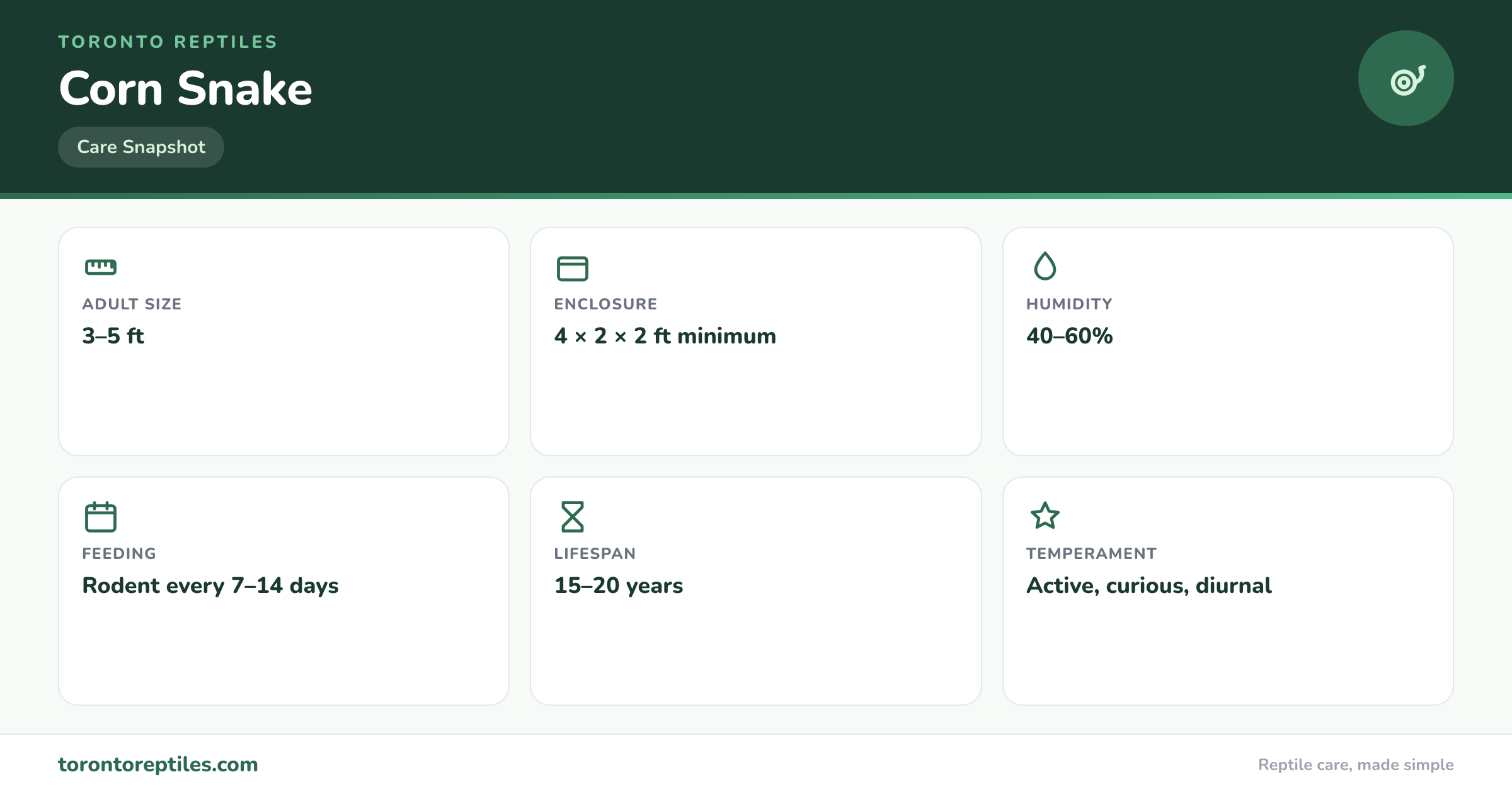
TL;DR: Corn snakes are the classic first snake: a 4 ft × 2 ft × 2 ft adult enclosure, 40–60% humidity, a frozen-thawed rodent every 7–14 days, and plenty of climbing clutter. Active, hardy, and 15–20 years of easy company.
This guide covers modern corn snake husbandry — enclosure sizing, temperature and humidity, feeding, handling, and common mistakes. If you’re comparing options, you might also want our ball python care guide — both are beginner snakes, but they have meaningfully different care needs.
Key Takeaways
- Adult corn snakes need a 4 ft × 2 ft × 2 ft enclosure minimum — front-opening glass or PVC.
- Humidity should sit at 40–60%, lower than tropical species — they’re native to the American Southeast.
- Feed appropriately-sized frozen-thawed rodents every 7–14 days, depending on age.
- Corn snakes are active and curious — they’ll explore constantly and need climbing branches, hides, and enrichment.
- Expected lifespan: 15–20 years in captivity with proper care.
Why Corn Snakes Are the Best Beginner Snake
There are five reasons corn snakes consistently top “best first snake” lists — and they matter because the differences between species are real, not marketing.
- Temperament. Corn snakes are calm, curious, and rarely bite. They adapt to handling faster than most species.
- Feeding reliability. Unlike ball pythons (notorious for food refusal), corn snakes almost always eat consistently. Beginners rarely deal with hunger strikes.
- Active personality. They’re crepuscular to diurnal, meaning you see them during normal waking hours — not hiding all day like many snakes.
- Size. They max at 5 feet and stay slender. Easy to handle, easy to house.
- Humidity tolerance. They don’t need tropical humidity, making them easier to keep correctly in dry climates and heated homes.
Enclosure Setup
Size
Modern husbandry standards are larger than older care guides suggest. Don’t trust any source that tells you a corn snake is “fine” in a 20-gallon long tank for life. Our corn snake size and growth guide covers the full adult length timeline and what to expect as your snake grows.
- Hatchlings: 10–20 gallon enclosure, upgrade quickly
- Juveniles (6–18 months): 40 gallon breeder minimum
- Adults: 4 ft × 2 ft × 2 ft (roughly 120 gallons) absolute minimum; 5 ft length is better
- Height matters: corn snakes climb, so vertical space is worth using
Substrate
- Aspen shavings — the corn snake classic, perfect for their dry-to-mid humidity range
- Cypress mulch — if you want a more naturalistic look and slightly higher humidity
- Bioactive substrate — the gold standard (see our bioactive terrarium guide)
- AVOID: pine or cedar (toxic), calcium sand (impaction risk), reptile carpet (difficult to clean deeply)
Hides and enrichment
Corn snakes are more active than ball pythons — they need more to do.
- At least 2 hides — one on the warm side, one on the cool side
- Climbing branches — they’ll use them regularly
- Water bowl large enough to soak in (they do, especially before shedding)
- Clutter and cover — artificial plants, cork bark, logs. An open enclosure stresses them.
- Digging substrate — they love to burrow under loose substrate
Temperature and Humidity
Heat gradient
| Zone | Day temperature | Night temperature |
|---|---|---|
| Warm side basking surface | 85–90°F / 29–32°C | Same or slightly cooler |
| Warm side ambient | 80–85°F / 27–29°C | 72–78°F / 22–26°C |
| Cool side ambient | 72–78°F / 22–26°C | 68–72°F / 20–22°C |
Use an overhead heat source (halogen bulb or radiant heat panel) controlled by a thermostat. Measure with a digital probe, not stick-on dial thermometers. Night-time cooling is natural for this species — don’t fight it with 24-hour heating.
Humidity
Corn snakes come from the American Southeast — a humid but not tropical climate. Maintain:
- Ambient humidity: 40–60%
- During shed cycles: 65–75% (briefly)
- Measure with: a digital hygrometer
Too-high humidity causes scale rot; too-low humidity causes incomplete sheds. A large water bowl and occasional light misting is usually sufficient.
UVB — debated but beneficial
Historically considered unnecessary for corn snakes. Modern research suggests low-level UVB (5% T5 HO) supports better overall physiology and colour development. Not required, but good husbandry.
Feeding
Prey size and type
Always frozen-thawed rodents, never live. The prey should be roughly the same width as the snake’s widest body point.
Feeding schedule by age
| Age | Prey size | Frequency |
|---|---|---|
| Hatchling (0–3 months) | Pinky mice | Every 5–7 days |
| Juvenile (3–12 months) | Fuzzy to hopper mice | Every 7 days |
| Sub-adult (1–2 years) | Adult mice or weaned rats | Every 7–10 days |
| Adult (2+ years) | Adult mice or small rats | Every 10–14 days |
Feeding technique
- Thaw rodents slowly (refrigerator overnight, then warm water for 10–20 minutes)
- Offer with long tongs — never by hand
- Wiggle slightly to trigger strike response
- Release tongs once the snake strikes; let it eat at its own pace
- Don’t handle for 48 hours after feeding
Feeding problems (rare in corn snakes)
Corn snakes rarely refuse food. If one does, the usual culprits are: temperature too low, stress from recent handling or relocation, shedding cycle, or (in adult males) breeding season. Missing one or two meals is normal; longer refusals warrant a vet check.
Handling
Corn snakes tolerate handling exceptionally well. Most become curious, calm, and relaxed with regular gentle handling.
- Wait 1–2 weeks after bringing home a new animal before handling
- Never handle within 48 hours of feeding
- Never during shed cycle (cloudy blue eyes = no handling)
- Support the body — hold at multiple points, let the snake move through your hands
- Sessions 10–20 minutes at a time, 3–4 times per week maximum
- Watch for stress signs: rapid tongue flicking (normal curiosity is slower), defensive s-coil, attempts to escape persistently
A well-socialized corn snake will happily drape across your shoulders and explore — part of why they’re so popular with keepers who want an “interactive” reptile experience without the intensity of larger species.
Common Health Issues
Respiratory infection
Signs: mucus, wheezing, gaping. Usually temperature-related. Fix husbandry immediately, see a reptile vet.
Mites
Tiny black specks near eyes or in water bowl. Treat with reptile-safe mite spray and deep-clean the enclosure.
Shedding issues
Incomplete sheds usually mean humidity was too low during the shed cycle. Warm water soak for 20 minutes, gently rub off stuck skin with a damp cloth.
Regurgitation
Handling too soon after feeding, or cool temperatures. Wait 7–10 days before offering another meal after a regurgitation, at a smaller size.
Cost in Canada (2026)
| Item | Cost range (CAD) |
|---|---|
| Corn snake (breeder, standard morph) | $80–$200 |
| Designer morphs (blood red, scaleless, etc.) | $200–$800+ |
| Enclosure (4ft PVC) | $350–$700 |
| Heat source + thermostat | $150–$300 |
| UVB bulb + fixture (optional) | $80–$150 |
| Substrate, hides, water bowl, decor | $100–$200 |
| Digital hygrometer + thermometer | $40–$80 |
| Initial vet check | $80–$150 |
| Total up-front | $880–$1,780 |
Ongoing monthly: $15–$30 for rodents. Annual: $150–$300 for bulb replacements and vet care. Over a 20-year lifespan: $5,000–$8,000 in total care costs.
Corn Snake vs. Ball Python — Which Is Right for You?
Both are marketed as beginner snakes. Here’s the honest comparison:
| Factor | Corn Snake | Ball Python |
|---|---|---|
| Activity level | High — active during day | Low — hides most of the time |
| Feeding reliability | Excellent — eats consistently | Variable — may refuse food |
| Adult size | 3–5 feet, slender | 3–5 feet, stocky |
| Temperament | Curious, exploratory | Calm, shy |
| Humidity needs | Moderate (40–60%) | High (60–70%) |
| Enclosure cost | Slightly lower | Slightly higher |
| Best for | Keepers who want to see their snake | Keepers who want a calm, low-demand animal |
If you want a snake you’ll see and interact with regularly, go with a corn snake. If you want a low-key companion you mostly admire in the enclosure, ball python. Both are excellent — just genuinely different personalities.
Frequently Asked Questions
How big do corn snakes get?
Most adults reach 3.5–5 feet in length. Females are often slightly larger than males. They stay slender throughout their lives. Our corn snake size guide covers the full growth timeline from hatchling to adult and how size affects enclosure planning.
How often do corn snakes eat?
Hatchlings every 5–7 days, juveniles every 7 days, adults every 10–14 days. Less often than people expect, especially as adults.
Are corn snakes good for kids?
Yes, with adult supervision. They’re among the most kid-tolerant snakes — calm, slow-moving, and rarely defensive. For a full comparison of reptile species that work well with children, our guide to the best kid-friendly reptiles covers what works across different age groups. Just ensure the responsible adult is always present with younger children.
Can two corn snakes live together?
No. Corn snakes are solitary, and cohabitation leads to stress, food competition, and occasional cannibalism. One snake per enclosure.
Do corn snakes bite?
Very rarely. When they do, bites are a quick pinch with no venom and no serious risk. Wash with soap and water. Most corn snakes go their entire lives without ever biting their keeper.
What colour morphs are available?
Corn snakes have one of the largest colour morph selections of any pet reptile — amelanistic, anerythristic, snow, blood red, lavender, scaleless, and dozens more. Prices range from $80 for standard morphs to $800+ for rare designer combinations. Our complete corn snake morphs guide covers the genetics behind each pattern and what drives the price variation between them.
Do I need a reptile vet?
Yes. Find one before an emergency. Not all vets treat reptiles. Several GTA clinics and the Ontario Veterinary College offer qualified reptile services.
Meet a Snake Before You Commit
One of the best ways to decide if snake-keeping is right for you is to spend time with one before committing. Meeting the animal first is a standard part of how we rehome — you’ll see exactly how a settled adult snake behaves, and we’ll talk through your setup honestly before anything changes hands.
This guide describes general husbandry practices and isn’t a substitute for veterinary care — the Association of Reptile and Amphibian Veterinarians maintains a directory of qualified exotics vets. Reptiles can carry Salmonella even when healthy, so follow Health Canada’s handling and hand-washing guidance, especially around young children.