
The difference between a closed terrarium that thrives for a decade and one that goes sour in three months usually comes down to plant selection. The layers can be perfect, the lighting can be right, the seal can be tight — and if the plants inside don’t like the conditions, nothing else matters.
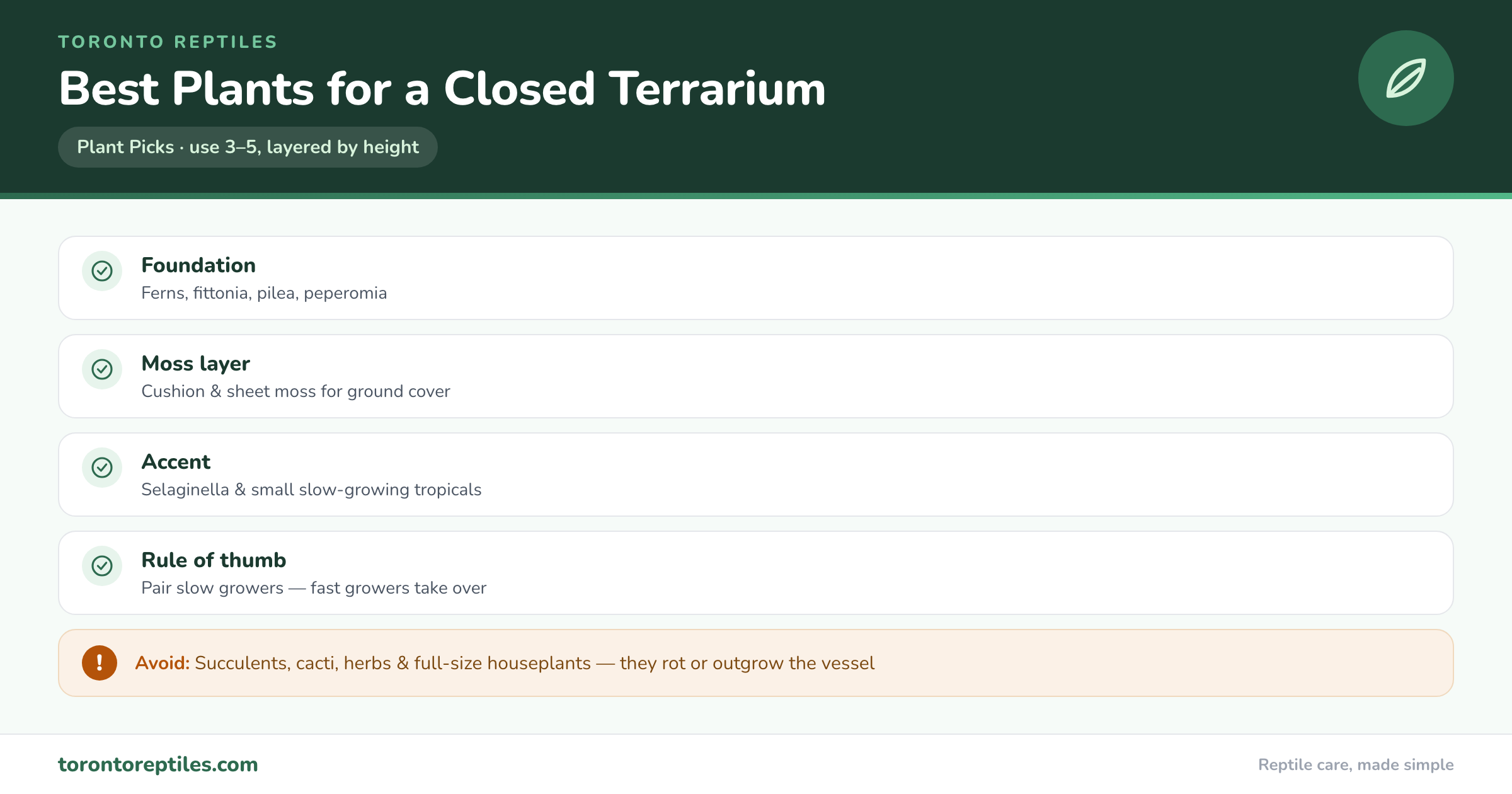
TL;DR: Pick small, slow-growing, humidity-loving tropicals — ferns, mosses, fittonia — and layer 3–5 of them by height: foundation plants, a moss carpet, and an accent. No succulents, cacti, or herbs; they rot or outgrow the jar.
This guide covers the plants that actually work in closed terrariums: the proven foundation species, the moss layer, the accent plants that add visual drama, the combinations that complement each other, and — just as important — the plants everyone tries to use that don’t belong inside a sealed vessel.
If you haven’t built your terrarium yet, start with our complete closed terrarium build guide first. This piece is focused on the plants themselves — what to choose, why, and how to combine them.
Key Takeaways
- The best closed terrarium plants are small, slow-growing, humidity-loving tropicals — ferns, mosses, fittonia, pilea, peperomia, and selaginella.
- Avoid succulents, cacti, herbs, and full-size houseplants — they’ll rot, outgrow the vessel, or die in the humidity.
- A good closed terrarium uses 3–5 plants layered by height: foundation plants, a moss layer, and optional accent plants.
- Pair slow-growing species together — a fast grower will dominate a sealed vessel within weeks.
- In Canada, the best plant sources are specialty plant shops and Canadian-based online terrarium suppliers (avoid big-box plants treated with systemic pesticides).
What Makes a Plant Good for a Closed Terrarium?
Four traits. A plant needs all four to work in a closed system.
- High humidity tolerance. The air inside a sealed terrarium is typically 90–100% humidity. Plants from desert or dry-temperate climates can’t handle this — they rot.
- Small adult size. A closed terrarium is inches-scale. Plants that get large (monstera, philodendron, dieffenbachia) will press against the glass and die within months.
- Slow growth. Fast growers dominate the vessel, out-compete neighbours, and require constant pruning. Slow, compact growers are your friends.
- Tolerance of indirect light. Closed terrariums should never be in direct sun — the glass magnifies heat. Plants that need full sun (most flowering species, succulents) won’t thrive.
Foundation Plants — The Workhorses
Pick 2–4 from this list for your primary planting. All of them are beginner-friendly, widely available in Canada, and slow enough to coexist.
Fittonia (Nerve Plant)
The classic. Small, low-growing, with striking pink, white, or red veining on green leaves. Tolerates a huge range of humidity and light levels, rarely exceeds 4–6 inches in a sealed vessel. Available everywhere, usually under $5. Start here if you’re not sure.
Pilea cadierei (Aluminum Plant)
Distinctive silver-green metallic markings, small rounded leaves, stays compact. Very forgiving of beginner mistakes. Pairs well with darker-leaved plants for contrast.
Peperomia (trailing varieties)
Peperomia prostrata (string of turtles) and P. rotundifolia (creeping peperomia) are the terrarium standards. Semi-succulent leaves, low water needs, happy in humid conditions despite the succulent-like appearance. Excellent ground cover.
Baby Tears (Soleirolia soleirolii)
Dense mat of tiny bright-green leaves. Spreads quickly to cover substrate surface. Needs consistent moisture — thrives in closed terrariums for exactly this reason. Can dominate a small vessel if not pruned, so use sparingly in jars under 2 quarts.
Button Fern (Pellaea rotundifolia)
Small, hardy fern with round dark-green leaflets. One of the more tolerant ferns for closed-terrarium conditions — unlike many ferns, it doesn’t require constant misting.
Rabbit’s Foot Fern (Davallia fejeensis)
Named for the fuzzy rhizomes that creep over the substrate surface (they look like small furry animal feet). Small, delicate fronds. Visually distinctive and a great textural contrast against flat-leaved foundation plants.
The Moss Layer
Moss is the single most underrated element in closed terrariums. It covers substrate (which looks better than bare dirt), retains moisture, grows incredibly slowly, and adds a soft organic texture that glass vessels lack.
Sheet Moss (Hypnum)
Flat, spreading moss that carpets the substrate surface. Available fresh from specialty suppliers or pre-dried (rehydrate before use). The most beginner-friendly option.
Cushion Moss (Leucobryum)
Forms domed, sculptural mounds in pale green. Long-lived in closed terrariums, often persisting for years. Pair with flat sheet moss for contrast.
Java Moss (Taxiphyllum barbieri)
Technically an aquatic moss, but tolerates high-humidity terrestrial conditions beautifully. Grows into a fine, tangled mat. Good for filling gaps around hardscape.
Mood Moss (Dicranum)
Like cushion moss but taller and shaggier. Creates dramatic tufts. Less common, more expensive, but visually striking when you can find it.
Important: preserved or reindeer moss (the dyed moss sold at craft stores) is dead. It looks nice but doesn’t contribute to the living system. Use live moss if you want your terrarium to function as a real ecosystem.
Accent Plants (Pick One)
These are the “statement” plants — one per vessel, chosen for visual drama. Use sparingly.
Selaginella (Spikemoss)
Fern-like foliage, dense growth, comes in bright green, bronze, or gold-tinted varieties. Absolutely requires high humidity — which is exactly what a closed terrarium provides. Will crumble and die in dry air.
Creeping Fig (Ficus pumila)
Fast-growing vine that climbs glass and hardscape. Creates a lush, overgrown jungle look. Requires pruning every 4–6 weeks or it’ll take over. Worth it if you want vertical coverage.
Miniature Orchids
Advanced choice. Species like Pleurothallis or small Masdevallia thrive in closed-terrarium humidity. More expensive and finicky but produce extraordinary tiny flowers. Don’t attempt as a first plant.
Small Bromeliads (Mini Neoregelia)
Cup-shaped rosettes in shades of red, pink, and green. Hold water in the central cup — can even house a tiny frog species in larger builds. Most dwarf cultivars stay under 3 inches.
Plants NOT to Use
These get suggested constantly and fail constantly. Skip them.
- Succulents (echeveria, jade, haworthia, crassula) — rot in high humidity within weeks
- Cacti — same problem, faster
- Air plants (Tillandsia) — they need airflow, not sealed humidity
- Full-size pothos, philodendron, monstera — will outgrow a 1-gallon vessel in under 3 months
- Herbs (basil, mint, rosemary) — wrong humidity profile, won’t flower or produce
- Edible plants — most need direct sun, which cooks closed terrariums
- Cut flowers or dried florals — will mould almost immediately
- Fast-growing vining plants (English ivy, sweet potato vine) — dominate the vessel
Plant Combinations by Vessel Size
Not sure what to pair together? Here are tested combinations that work visually and biologically.
Small vessel (pint or quart jar)
- 1 fittonia (foreground)
- 1 small peperomia (background)
- Sheet moss carpeting the substrate
- Optional: a single small stone or piece of driftwood
Medium vessel (2-quart or small terrarium)
- 1 button fern (back-centre)
- 1 fittonia (front-left)
- 1 small peperomia (front-right)
- Cushion moss + sheet moss carpet
- Small cork-bark hardscape element
Large vessel (gallon+ terrarium)
- 1 rabbit’s foot fern (back)
- 1–2 fittonia in different colours (mid-ground)
- 1 peperomia trailing over hardscape
- 1 selaginella as accent
- Sheet moss + cushion moss + small java moss patches
- Driftwood piece + 2–3 small stones
The principle: vary height, leaf shape, and colour — not too many species. Three to five well-chosen plants look better than a crowded mix of ten.
Where to Buy Closed Terrarium Plants in Canada
Specialty plant shops (best option)
Shops that specifically carry terrarium plants — Plantarium, Crown Flora, Leaf & Pine, and Canadian Tropicals — stock small, healthy, pesticide-free plants specifically for closed-system use. Prices run $5–$15 per plant. Worth the premium.
Online Canadian terrarium suppliers
Several Canadian-based online sellers specialize in mail-order terrarium plants. Advantages: curated selections, detailed care notes, often shipped in root plugs ready to plant. Disadvantages: shipping fees, seasonal limits in winter (plants need heat packs below freezing).
Propagated from your own plants
Once you have one terrarium running, you can propagate starter cuttings from it for free. Fittonia, peperomia, and creeping fig root easily from stem cuttings.
Avoid
- Big-box hardware stores — plants are often treated with systemic pesticides that kill invertebrate clean-up crews and can stress sensitive plants
- Generic houseplant sections — plants are usually too large for terrarium use
- Unverified marketplace listings — species identification is often wrong
Can I Add Isopods to My Closed Terrarium?
Yes — and doing so turns your closed terrarium into a fully bioactive system that maintains itself even more effectively. A small clean-up crew of isopods and springtails will process any dead plant matter, keep mould in check, and add a subtle layer of activity to watch. For full details, see our complete isopod terrarium guide and our bioactive terrarium build guide.
Frequently Asked Questions
How many plants can I fit in a one-gallon terrarium?
Three to five individual plants, plus a moss layer. More than that and they’ll crowd each other. Remember plants will also grow — what looks sparse on day one will look full by month six.
Do closed terrarium plants need fertilizer?
No. The closed ecosystem recycles its own nutrients through decomposing plant matter. Adding fertilizer disrupts the balance and often causes algae or bacterial blooms.
How long do closed terrarium plants live?
In a well-built system, 5–10+ years is realistic. Some species will slowly reach the edges of the vessel and need occasional pruning; a few (like fittonia) may eventually die of old age and need replacing, but most plants persist indefinitely.
Can I use moss from my backyard?
Not recommended. Wild-collected moss often brings pests, fungi, or unknown chemistry. It also might not tolerate the high humidity of a closed vessel. Use moss from a specialty supplier.
What if I don’t have a window with bright indirect light?
Grow lights work perfectly. A small LED plant light on a 10–12 hour timer costs under $30 and is ideal for closed terrariums. Many hobbyists actually prefer grow lights — they’re more consistent than window light.
My fittonia wilted overnight — is it dying?
Fittonia is the terrarium drama queen — it wilts dramatically when stressed but bounces back within hours. If it happens right after planting, it’s almost always from root disturbance. Give it 24 hours before worrying.
Putting It All Together
Choosing plants from a list is one thing. Arranging them in glass — balancing heights, textures, and growth rates — is the fun part. Plant the foundation species first, firm the substrate gently around delicate fittonia roots, and leave more empty space than feels right: a new build should look about 60% planted.