

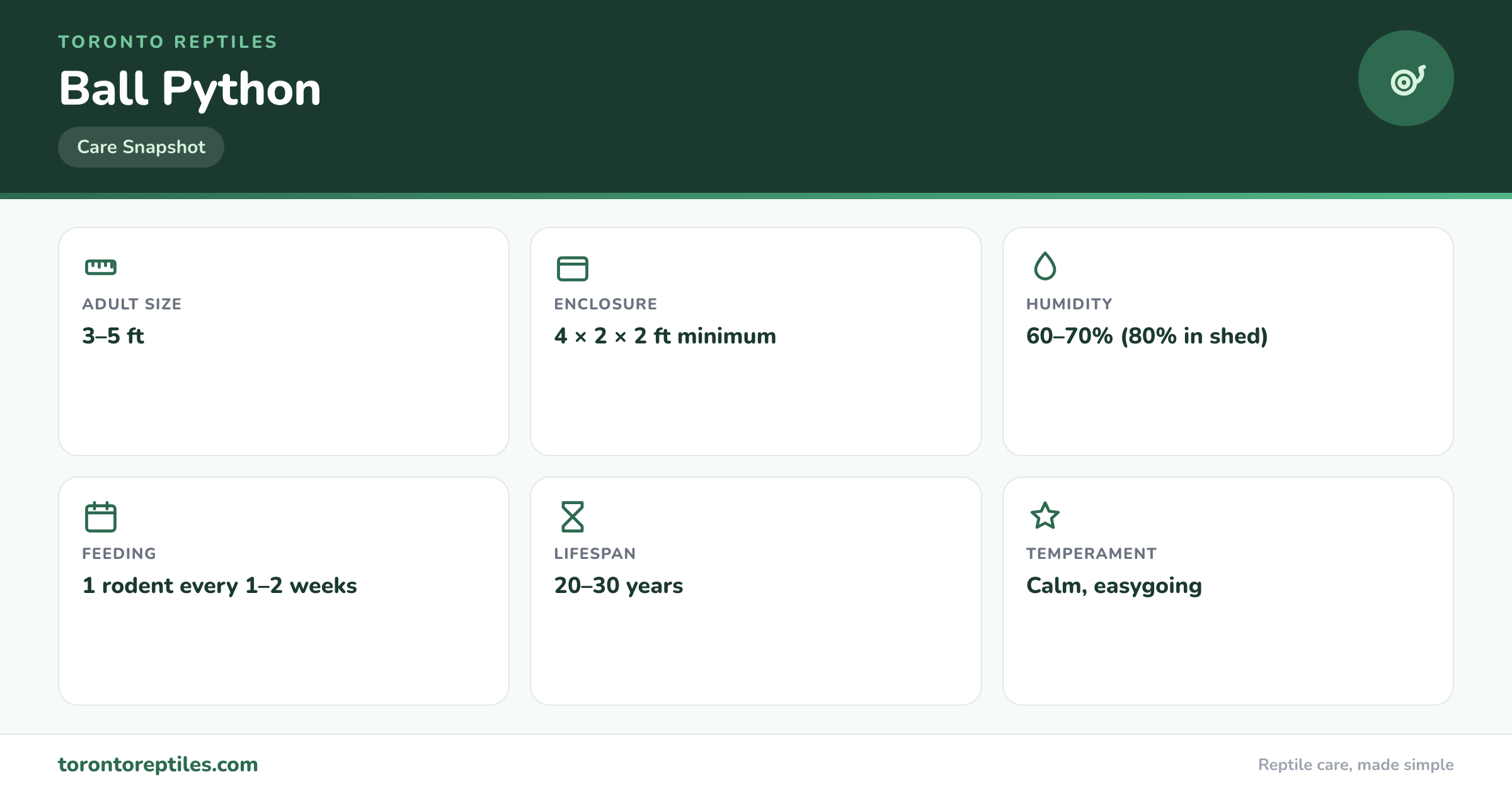
Ball pythons (Python regius) are the most commonly kept pet snake in the world — and for good reason. They stay small (3–5 feet at most), they’re calm to the point of being lazy, they only need to eat once every 1–2 weeks, and they live 20–30 years in good care. They’re also one of the most misunderstood reptiles in the hobby, partly because their care standards have evolved significantly in the last decade. They’re also one of the species we rehome most often — there are ball pythons looking for new homes with us right now.
TL;DR: Give a ball python a 4 ft × 2 ft × 2 ft enclosure, 60–70% humidity, two snug hides, and one appropriately sized frozen-thawed rodent every 1–2 weeks. Get heat, humidity, and clutter right and this shy, hardy snake can live 20–30 years.
This guide covers modern ball python husbandry — enclosure sizing, heat and humidity, feeding schedules, handling, and common health issues. The advice here reflects current best practices as of 2026, which differ meaningfully from what you’ll still find in older care guides and pet-store handouts.
Key Takeaways
- Adult ball pythons need an enclosure of at least 4 ft × 2 ft × 2 ft — larger than most pet stores recommend.
- Humidity must stay 60–70% ambient, spiking to 80% during shedding.
- They eat every 1–2 weeks as adults — one appropriately-sized rodent. That’s it.
- Ball pythons are ambush predators — they need hides, clutter, and visual barriers, not open tanks.
- Expected lifespan: 20–30 years in captivity. This is a longer commitment than most dogs.
Choosing a Ball Python
Buy from a reputable breeder — not a pet store or reptile expo with unverified origins — or consider a rehomed adult whose feeding history and temperament are already known. Well-bred ball pythons come from lineage with known genetics, documented feeding history, and confirmed captive-bred status (never wild-caught).
Signs of a healthy ball python
- Active tongue-flicking when approached
- Round, muscular body — not triangular or sunken
- Clear eyes with no cloudiness (unless in a shed cycle, which causes temporary blue-grey eyes)
- Clean vent with no crust or discharge
- Alert response to movement and gentle touch
- Eating consistently — ask the breeder for the feeding log
Avoid
- Snakes with wrinkled skin (dehydration)
- Mites (small black specks near the eyes or in the water dish)
- Refusal to move when gently touched
- Mouth held open or wheezing sounds (respiratory infection)
Enclosure Setup
Size
Modern ball python husbandry recommends significantly larger enclosures than the “they like tight spaces” mythology of older care guides. Adults need:
- Minimum: 4 ft long × 2 ft deep × 2 ft tall (approximately 120 gallons)
- Recommended: 5–6 ft long × 2 ft deep × 2 ft tall
- Juveniles can start in 40-gallon breeders but will outgrow them by month 8–12
A larger enclosure allows proper thermal gradients, space for multiple hides, and natural behaviour like exploration and climbing.
Substrate
Good options, ranked:
- Bioactive substrate (cypress mulch + coconut fiber + sphagnum + live plants + clean-up crew) — best for humidity and welfare. See our bioactive terrarium guide for setup details.
- Cypress mulch — holds humidity well, naturalistic
- Coconut husk (ReptiChip) — excellent humidity retention
- Aspen shavings — only for drier conditions (not ideal for ball pythons specifically)
- AVOID: pine or cedar (toxic), sand (wrong for this species), paper towels (acceptable for quarantine only)
Hides and enrichment
Ball pythons are ambush predators. They need to feel hidden at all times to feel safe. Provide:
- At least 2 hides — one on the warm side, one on the cool side, both snug enough that the snake touches the top and sides when curled inside
- Climbing branches — ball pythons climb more than older guides claim, especially juveniles
- Visual barriers — plants (live or artificial), cork bark, clutter that breaks up the enclosure
- Water bowl large enough for the snake to fully soak in — they do this regularly, especially before shedding
Temperature and Humidity
Heat gradient
| Zone | Day temperature | Night temperature |
|---|---|---|
| Warm side basking surface | 88–92°F / 31–33°C | Same or slightly cooler |
| Warm side ambient | 82–85°F / 28–29°C | 78–82°F / 25–28°C |
| Cool side ambient | 75–80°F / 24–27°C | 72–76°F / 22–24°C |
Use an overhead heat source (radiant heat panel or deep-heat projector) controlled by a thermostat. Under-tank heaters are falling out of favour in modern husbandry because they don’t create air-temperature gradients — they only heat a small belly zone. Measure with a digital probe thermometer, not stick-on dial thermometers (which read inaccurately).
Humidity
Ball pythons come from West African forest-edge environments — they need more humidity than older guides suggest:
- Ambient: 60–70%
- During shed cycles: 75–85%
- Measure with: a digital hygrometer (analog dials are unreliable)
Maintain humidity by choosing the right substrate, providing a large water bowl, misting the enclosure 1–2 times per week, and ensuring partial coverage on the top of the enclosure (full mesh tops dry out fast).
UVB — debated but increasingly recommended
Ball pythons were long thought not to need UVB. Modern research suggests low-level UVB (5% T5 HO) supports better overall health and behaviour. Not strictly required, but recommended in welfare-focused husbandry.
Feeding
Prey size and type
Feed appropriately-sized frozen-thawed rodents — the prey should be roughly the same width as the snake’s widest body point (not head, body). Live feeding is discouraged because mice and rats can injure the snake.
Feeding schedule by age
| Age | Prey size | Frequency |
|---|---|---|
| Hatchling (0–4 months) | Pinky mice | Every 5–7 days |
| Juvenile (4–12 months) | Hopper/fuzzy mice, then small rats | Every 7–10 days |
| Sub-adult (1–3 years) | Small to medium rats | Every 10–14 days |
| Adult (3+ years) | Medium to large rats | Every 14–21 days |
Feeding technique
- Thaw frozen rodents in the refrigerator overnight, then in warm (not hot) water for 10–20 minutes before feeding
- Present the prey with long tongs (30cm+) — never with your hands
- Wiggle the prey in front of the snake to trigger strike response
- Once the snake strikes, release the tongs and let it constrict and swallow at its own pace
- Don’t handle the snake for 48 hours after feeding (risks regurgitation)
Refusing food
Ball pythons are notorious for refusing food — it’s the most discussed topic in the hobby. Common causes: too-cool temperatures, stress (recent move, handling during shed), breeding season (adult males especially), or illness. A healthy adult can skip 4–8 weeks of meals without any concern. If it goes longer or the snake is losing significant weight, see a reptile vet.
Handling
Ball pythons are among the calmest snakes in the hobby — but they’re still snakes, not social animals. Handle for enrichment, not entertainment.
- Let new animals settle for 2 weeks before handling
- Never handle within 48 hours of feeding
- Never handle during a shed cycle (cloudy eyes = blue phase, no handling)
- Support the body fully — hold at two points, let them move through your hands
- Sessions under 15 minutes are kinder than long handling periods
- Watch for stress signs: repeatedly trying to retreat, tail rattling, defensive s-coil, hissing
Handle 2–3 times per week maximum. Ball pythons that are over-handled become stressed and stop eating — a common beginner mistake driven by excitement.
Common Health Issues
Respiratory infection
Signs: mucus around mouth, wheezing, gaping. Usually caused by cool temperatures or wrong humidity. Correct husbandry immediately and see a reptile vet.
Mites
Tiny black insects near the eyes or in the water bowl. Requires treatment with reptile-safe mite spray and full enclosure deep-clean. Quarantine new animals to prevent introduction.
Shedding issues
Incomplete sheds (stuck eye caps, retained tail tip) are usually caused by low humidity. Soak the snake in warm water for 20 minutes, gently rub off stuck skin. Fix humidity long-term.
Scale rot
Red, swollen, or cracked belly scales from overly damp substrate. Correct moisture, increase ventilation, possibly treat with chlorhexidine. Severe cases need vet care.
Obesity
Surprisingly common in pet ball pythons. Caused by feeding too often or too-large prey. Symptoms: rolls of fat visible near the vent, the snake becomes lethargic. Reduce feeding frequency.
Cost in Canada (2026)
| Item | Cost range (CAD) |
|---|---|
| Ball python (from reputable breeder) | $150–$400 (normal morphs); $500–$2,500+ (designer morphs) |
| Enclosure (4 ft PVC or wood) | $400–$900 |
| Heat panel + thermostat | $180–$350 |
| UVB bulb + fixture (optional) | $80–$150 |
| Substrate, hides, water bowl, decor | $100–$250 |
| Digital hygrometer + thermometer | $40–$80 |
| Initial vet check | $80–$150 |
| Total up-front | $1,030–$2,280 |
Monthly ongoing: $15–$35 for rodents (frozen). Annual vet and bulb replacements: ~$200. Over a 25-year life, you’re looking at roughly $6,000–$10,000 in total care costs. Ball pythons are more expensive to keep correctly than most beginner-guide pricing suggests. The animal itself varies widely in price based on morph genetics — from around $150 for a normal to several thousand for a designer combination. Our guide to ball python morphs explains what drives those price differences.
Is a Ball Python Right For You?
Ball pythons are an excellent choice if you want: a relatively calm snake, a pet that’s content with infrequent handling, a very long-lived reptile, and a species with a massive community for support. They’re not a great choice if you want: an “interactive” pet, a snake that’s always visible (they hide most of the day), or a short-term commitment.
Most first-time snake keepers find ball pythons more rewarding than they expect, but only once they accept the species on its own terms — a shy ambush predator that’s happy to be left alone most of the time.
If you’re not sure yet, reach out about meeting one of the snakes currently in our care. Part of how we rehome is a conversation and a meet-up before any commitment — a low-stakes way to find out whether snake-keeping is actually for you.
Frequently Asked Questions
How often do ball pythons need to eat?
Adults eat every 1–2 weeks; juveniles every 5–10 days. Don’t overfeed — obesity is more common than underfeeding in captivity.
Can ball pythons be housed together?
No. They’re solitary animals and cohabitation causes stress, food competition, and disease transmission. One snake per enclosure.
Do ball pythons bite?
Rarely. When they do, it’s usually a feeding-response mistake (fingers that smell like rodents) or a genuinely stressed defensive bite. Neither type is dangerous — bites leave pinprick marks that bleed briefly. Wash with soap and water.
How long do ball pythons live?
20–30 years in captivity with proper care. Wild ball pythons live 10–15 years. The longest documented captive ball python reached 62 years old.
Are ball pythons good for beginners?
Among the best beginner snakes, yes — but “beginner” here means “first-time snake owner,” not “first-time pet owner.” They still require specific equipment, a multi-decade commitment, and a willingness to learn.
What’s the difference between a ball python and a boa constrictor?
Size (ball pythons max at 5 feet; boas can reach 10+ feet), temperament (both calm but boas are more active), and care specifics (humidity, feeding size, enclosure dimensions). Both are excellent pets in experienced hands.
Do I need a reptile vet?
Yes — find one before you need one. Not all vets treat reptiles. The Ontario Veterinary College and several GTA-area clinics offer qualified reptile services, and the Association of Reptile and Amphibian Veterinarians maintains a directory of qualified exotics vets.
Adopt a Ball Python in Toronto
Several ball pythons are looking for new homes with us right now, including a normal ball python, a black pastel, and a blue-eyed leucistic. Each listing covers temperament, feeding history, and the setup the snake is used to, and we stay available for questions after every rehoming.
This guide describes general husbandry practices and isn’t a substitute for veterinary care — if your snake shows signs of illness, see a qualified reptile vet. Reptiles can carry Salmonella even when healthy, so follow Health Canada’s handling and hand-washing guidance, especially around young children.