

An isopod terrarium is a small, self-sustaining habitat built specifically for a colony of land-dwelling isopods — the tiny crustaceans better known as pill bugs, roly-polies, or woodlice. Unlike a traditional reptile setup, the isopods are the pets. They’re also one of the most overlooked entry points into the terrarium hobby: cheap to start, ethically easy, endlessly watchable, and quietly one of the best ways to teach kids about ecosystems. And if the colony sparks a bigger reptile obsession later, adopting beats buying.
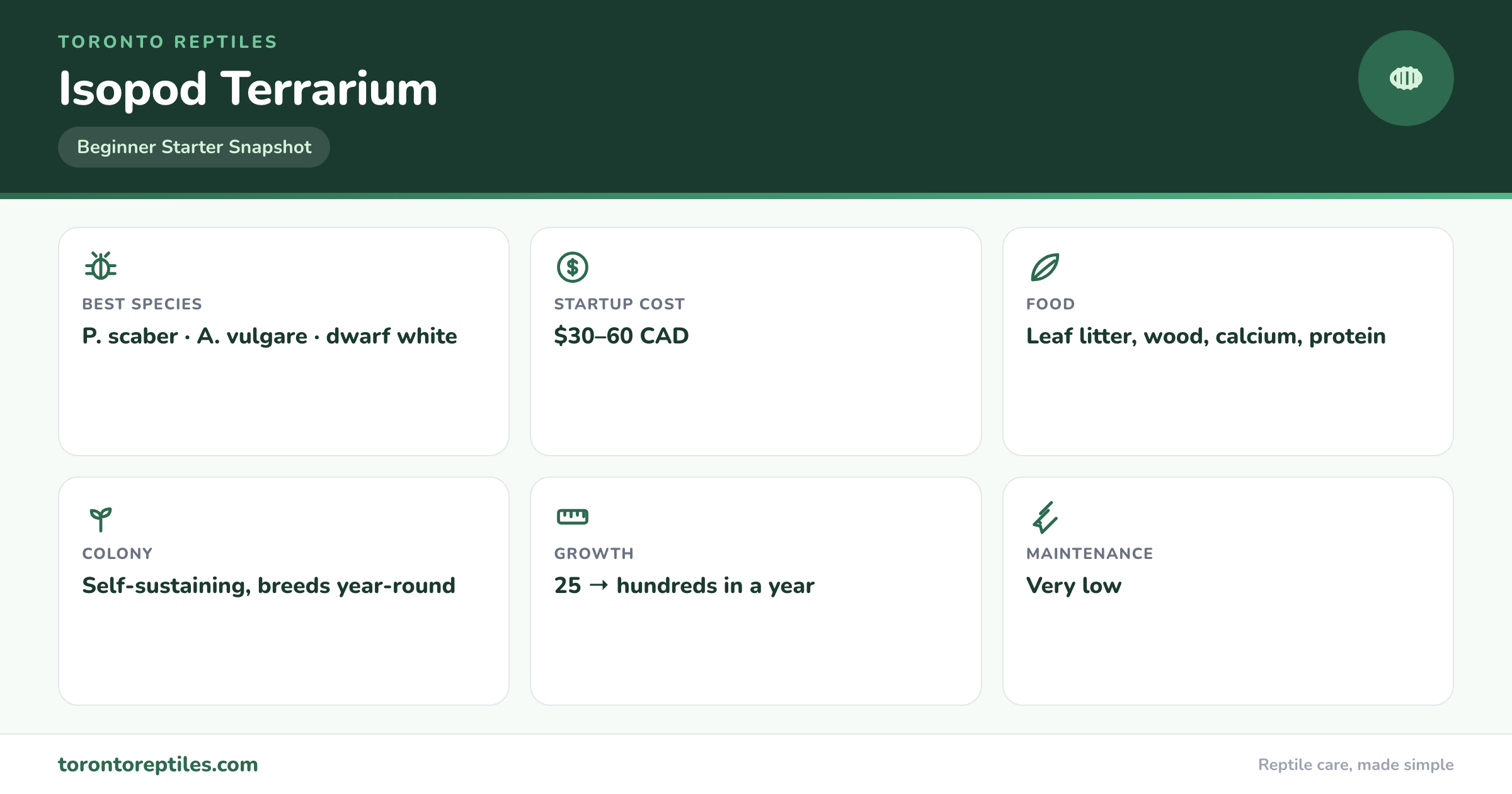
TL;DR: An isopod terrarium keeps the clean-up crew as the pet: a jar, 7–10 cm of substrate, leaf litter, a calcium source, and a starter culture — from about $30–$60 in Canada. Porcellio scaber and common pill bugs are the beginner species.
People tend to discover isopods sideways — they buy a handful as a clean-up crew for a bearded dragon, a crested gecko, or a tarantula, and a few months later they’re staring into the enclosure realizing the isopods themselves are the most interesting thing in there. The next step is usually building a dedicated isopod setup.
This guide covers everything — the best species for beginners, how to set up the habitat, feeding, breeding, common problems, and where to source healthy cultures in Canada. If you’ve already read our guide to bioactive terrariums, this is its logical next chapter.
Key Takeaways
- An isopod terrarium is a small enclosure designed to house isopods as pets — not just as a clean-up crew for other animals.
- Best beginner species are Porcellio scaber (common rough woodlouse), Armadillidium vulgare (pill bug), and Trichorhina tomentosa (dwarf white).
- You can start with as little as $30–$60 in Canada — a jar, substrate, leaf litter, and a starter culture.
- Isopods need calcium, decomposing wood, leaf litter, and protein occasionally — not fresh produce alone.
- A healthy colony is self-sustaining and breeds year-round indoors. Most starter cultures of 25 become populations of hundreds within a year.
What Is an Isopod Terrarium?
An isopod terrarium is a dedicated display and breeding habitat for a single isopod species (or sometimes a few compatible species). The enclosure is usually small — anything from a large mason jar to a 5-gallon glass tank — and designed around what isopods actually need: moisture gradients, hiding spots, decomposing matter to eat, and calcium sources for their exoskeletons.
What makes an isopod terrarium different from a generic bug tank is the ecosystem framing. A good isopod setup has live springtails, some leaf litter, sometimes live moss, and a rotting piece of hardwood. The colony eats its way through that substrate slowly, and the enclosure develops a personality over time — you’ll have favourite individuals you recognize by colouring, you’ll see juveniles for the first time, and you’ll watch them cluster in social groups under their favourite piece of bark.
Hobbyists who keep isopods seriously often have a dozen species in parallel, each in their own small tub — a phenomenon in the community called “the shelf.” It starts with one.
Best Isopod Species for Beginners
There are over 10,000 isopod species worldwide, and a few dozen are commonly kept in the hobby. For a first-time keeper, you want species that: breed readily at room temperature, tolerate a range of humidity, don’t require exotic food, and are visually interesting. These five fit the bill.
| Species | Common name | Size (adult) | Difficulty | Notes |
|---|---|---|---|---|
| Porcellio scaber | Common rough woodlouse | 12–15mm | Beginner | The default. Hardy, forgiving, huge colour morphs available (orange, dalmatian, lava). |
| Armadillidium vulgare | Pill bug / roly-poly | 10–18mm | Beginner | The classic “roly-poly” — rolls into a ball when threatened. Slow-breeding but low-maintenance. |
| Trichorhina tomentosa | Dwarf white | 3–5mm | Beginner | Tiny, fast-breeding, prefers humid setups. The workhorse clean-up crew for bioactive enclosures. |
| Porcellio laevis | Dairy cow isopod | 15–20mm | Intermediate | Large, active, distinctive black-and-white. Needs more calcium than most. |
| Cubaris murina | Little sea | 8–10mm | Intermediate | Tropical, humid-loving, dark grey. A good entry into the Cubaris genus. |
The exotic Cubaris morphs you’ll see on Instagram — rubber ducks, panda kings, shiro utsuri — are stunning, but they’re expensive (starter cultures run $150–$400 CAD), slow-growing, and demanding. Leave them until after your first species is thriving.
Setting Up an Isopod Terrarium: Step by Step
The build is simple enough that a kid can do it in 30 minutes — which is why isopod builds are our favourite way to introduce kids to the hobby. If you want to pair your isopod colony with a fully planted display, our DIY terrarium kit guide covers the complete layered build. Here’s the exact process for a dedicated isopod setup.
1. Choose your enclosure
For a starter colony of 25 isopods, you need surprisingly little space. A 6-quart plastic shoebox, a 1-gallon glass jar, or a small 2.5–5 gallon terrarium all work. Ventilation matters more than size — drill a few small holes in the lid, or use a vented terrarium with a mesh top.
2. Layer the substrate
Unlike a full bioactive reptile enclosure, an isopod setup doesn’t need a drainage layer — the animals stay close to the surface. A single layer system works fine:
- Base: 2–3 inches of bioactive substrate — coco fiber, organic topsoil, and decomposing hardwood bark mixed together
- Middle: chunks of rotting hardwood (oak, maple, beech) — this is what most species actually eat
- Top: 1–2 inches of leaf litter — dried magnolia, sea almond, oak, or live oak leaves
- Optional: a handful of live moss (cushion moss or java moss), and a small piece of cork bark for hiding
3. Moisten the substrate
Most species thrive in a humidity gradient — one side damper than the other. Lightly mist one corner of the enclosure until it’s damp but not waterlogged. Leave the other side drier. Isopods self-select the moisture they need.
4. Add calcium sources
Isopods are crustaceans — they need calcium to molt. Without it, colonies stall. Add one or two of: cuttlebone (broken into pieces), crushed eggshells (boiled first to sterilize), or a small piece of limestone. Replace every 2–3 months as it gets consumed.
5. Introduce the colony
Gently empty your starter culture onto the leaf litter and let them disperse. Don’t dig them up or relocate them — they’ll find their preferred spots within a few hours.
6. Seed springtails
Add a small culture of springtails (5–10ml worth, roughly). They’ll keep mold in check, eat decomposing matter too small for the isopods, and won’t compete for food. The two species happily coexist.
7. Leave them alone
Resist the urge to check on them every hour. Isopods are shy in a new setup. Give them a full week to settle before you expect to see them active.
What to Feed Your Isopods
The biggest mistake new keepers make is feeding isopods only fresh vegetables. Isopods are primarily detritivores — they eat decomposing plant matter, decaying wood, and dead animal material. Fresh veggies are a supplement, not the main diet.
Staple foods (always available)
- Leaf litter — their primary food. Top up every 2–3 months.
- Rotting hardwood — oak, maple, beech. Bury chunks in the substrate.
- Calcium source — cuttlebone or crushed eggshell, permanently available.
Supplemental foods (small amounts, every few days)
- Fresh vegetables — zucchini, cucumber, carrot, sweet potato. Thin slices.
- Fruit — apple, banana, mango. Sparingly — attracts fruit flies.
- Protein — fish flakes, repashy bug burger, a piece of cooked shrimp once a week. Essential for breeding.
What not to feed
- Citrus fruits (too acidic)
- Anything treated with pesticides
- Onion or garlic
- Dairy or bread (moulds instantly)
Remove uneaten fresh food after 2–3 days to prevent mould and mite outbreaks. Springtails will eat whatever’s left behind.
Breeding and Colony Growth
A healthy isopod colony breeds continuously at room temperature (20–24°C) — no special triggers needed. Gravid females carry their young in a marsupium-like pouch under their body, and release miniature copies of themselves (called “mancae”) after 3–5 weeks.
You typically won’t see anything happening for the first 6–8 weeks after introducing a starter colony — this is when the adults are acclimatizing and producing the first generation. Around month 3, you’ll start spotting tiny white mancae in the leaf litter. By month 6, you’ll have visible colony expansion. By month 12, most beginner species will have produced hundreds of offspring from an initial culture of 25.
Breeding speed by species
| Species | Approx. generation time | Breeding pace |
|---|---|---|
| Trichorhina tomentosa (dwarf white) | 6–8 weeks | Very fast |
| Porcellio scaber | 10–12 weeks | Fast |
| Porcellio laevis | 12–14 weeks | Moderate |
| Armadillidium vulgare | 14–16 weeks | Slow-moderate |
| Cubaris species | 16–24+ weeks | Slow |
Once your colony hits a few hundred individuals, you have options. Split it into a second enclosure. Trade starter cultures with other hobbyists. Use them as a clean-up crew for a reptile enclosure — they integrate especially well in a ball python bioactive setup. Or just enjoy the growing community in its habitat — they’re more sociable than people assume, and watching juveniles mingle with adults under a piece of cork is one of the small joys of the hobby.
Troubleshooting Common Problems
The colony isn’t growing
Most often a calcium or protein issue. Check that your cuttlebone is still intact. Add a small fish-flake protein supplement 1–2 times per week. Also confirm humidity — too dry and isopods won’t breed.
Mites appearing
Small white grain mites usually appear when fresh food is left too long. Remove the uneaten food, dry out the enclosure slightly, and increase the springtail population. The springtails will out-compete the mites within a few weeks. Predatory mites are rare but can be treated with a predator mite release if needed.
Fruit flies
Almost always caused by fresh fruit left in the enclosure. Remove fruit feedings for two weeks, let the population crash, then resume with smaller portions and better ventilation.
Dying isopods in one specific area
Usually a localized waterlogging issue. Check if one corner is significantly wetter than the rest — if so, reduce misting on that side and add a handful of dry leaf litter to absorb excess moisture.
Mould blooms
Too wet, not enough springtails, or organic matter going anaerobic. Reduce humidity, increase airflow, add more springtails, remove the mouldy material. Light surface mould is normal and the clean-up crew will deal with it; fuzzy black or green mould needs removing.
Where to Buy Isopods in Canada
As of 2026, there are several reliable sources for starter cultures in Canada. CBSA regulations require isopods to be shipped from domestic breeders — never order from US sites, as cross-border shipping of live invertebrates can lead to seized packages and dead cultures.
Recommended sources
- Local reptile expos — events like the Canadian Reptile Expo (Ontario) and BC Reptile & Amphibian Expo typically have several isopod breeders
- Specialist Canadian breeders — a number of hobbyists sell through Facebook groups and Instagram; prices range from $20 (starter cultures of hardy species) to $400+ (rare Cubaris morphs)
- Reptile specialty stores — GTA shops like Reptilia Zoo and some independent stores stock common species in small volumes
- Ontario Reptile Keepers group (Facebook) — active community for trading and buying
Before buying, ask the breeder: how long has this specific colony been established, what substrate it’s being kept on, and whether it’s been exposed to any other species recently. A well-established colony from a careful breeder is worth paying a bit more for.
Frequently Asked Questions
Are isopods safe to keep around kids?
Completely. Isopods don’t bite, sting, or carry human diseases. They’re one of the most kid-appropriate pets in the invertebrate world — we’ve used them with kids for years.
How long do isopods live?
Individual isopods typically live 1–3 years depending on species. But because a colony reproduces continuously, the population as a whole persists indefinitely with proper care.
Can I keep multiple isopod species together?
In theory yes, but most experienced keepers don’t. Species have different temperature and humidity preferences, and faster-breeding species will out-compete slower ones. Keep species separate until you know what each needs.
Do isopods smell?
A healthy isopod enclosure smells like a forest floor — earthy, slightly damp, not unpleasant. If it smells sour or rotten, something has gone anaerobic and needs addressing.
Can I release isopods into my garden?
In Canada, no — do not release non-native invertebrate species into the wild. If you need to rehome excess, find another hobbyist to trade with or use them as clean-up crew in another enclosure.
What’s the difference between springtails and isopods?
Both are clean-up crew, but springtails (under 2mm) focus on mould and microscopic decomposers, while isopods (5–20mm) eat bulk material like leaf litter, wood, and waste. In a bioactive setup, you want both.
How many isopods do I need to start?
A starter culture of 15–25 adults of a breeding species is plenty. You don’t need hundreds — the population grows naturally once the habitat is stable.
Start Small, Then Go Bigger
Isopod terrariums are one of the best “first builds” for kids, first-time terrarium keepers, and anyone curious about ecosystems without the commitment of a reptile. Start with a jar and a starter culture, learn what the colony teaches you, and scale up from there.
Want more? Read our companion complete guide to bioactive terrariums — the full ecosystem approach to reptile and invertebrate keeping.