
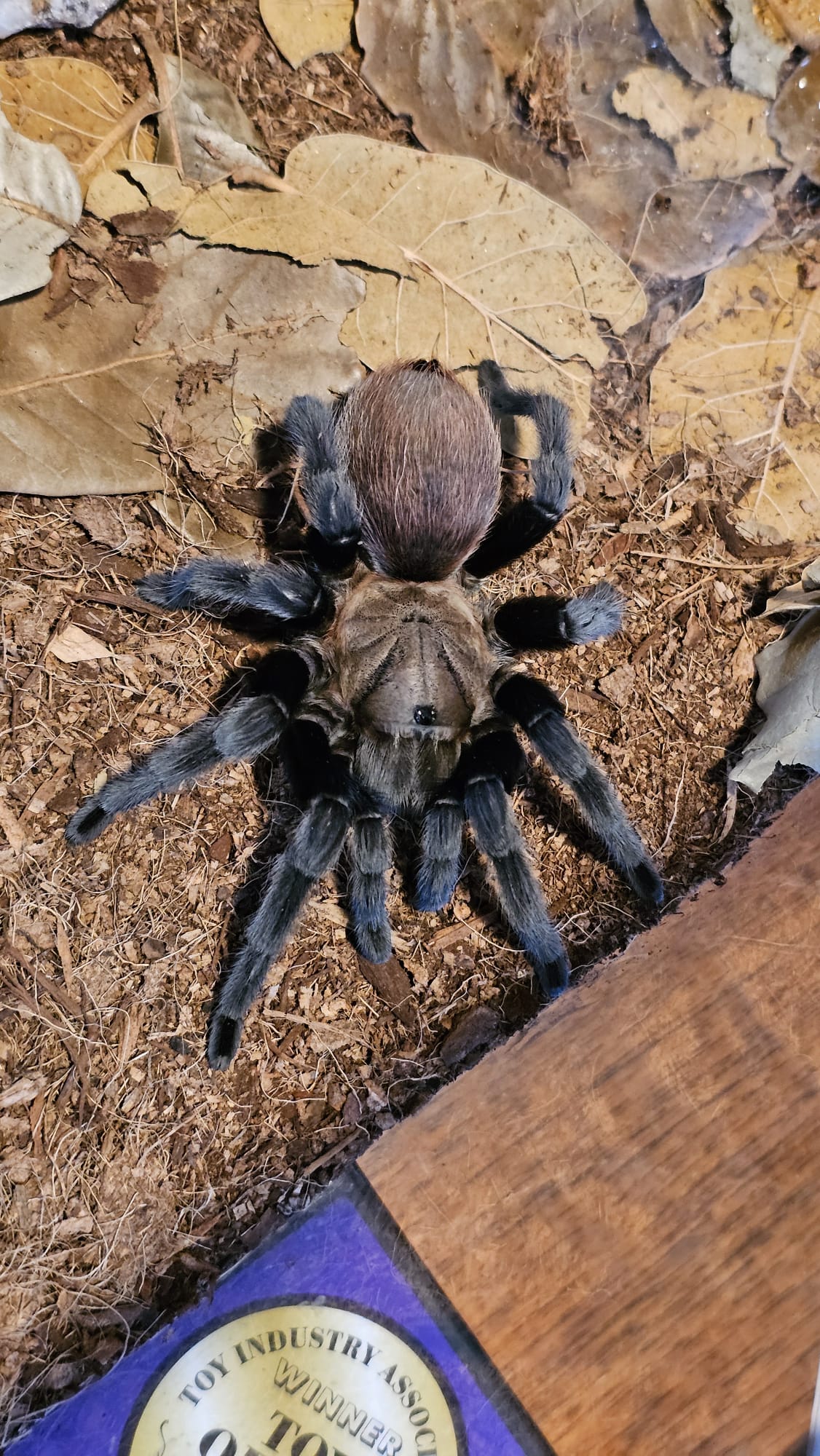
Meet Katara, our Texas brown tarantula (Aphonopelma hentzi) — and quite possibly the most low-maintenance resident in the house.
Texas browns are one of the classic beginner tarantulas for good reason. They’re terrestrial, slow-moving, and remarkably even-tempered, with none of the speed or attitude of the old-world species. Katara spends most of her time sitting calmly at the mouth of her burrow, occasionally rearranging her substrate to her own satisfaction, and moves with the unhurried confidence of an animal that has never been in a rush.
Her setup is simple. A wide, low enclosure matters far more than a tall one — tarantulas are ground-dwellers and a fall can injure them. She has several inches of dry substrate to burrow into, a cork bark hide, and a shallow water dish. No heat lamp, no UVB: normal room temperature is fine, which makes her one of the cheapest animals here to run.
Feeding is refreshingly undramatic. A couple of appropriately sized crickets or a dubia roach every week or two is plenty. Adults can go surprisingly long between meals without concern, and she’ll refuse food entirely in the run-up to a moult — which is normal, not a cause for alarm.
She’s a look-don’t-touch animal, and that’s the point. Tarantulas don’t enjoy handling the way a bearded dragon might tolerate it, and dropping one does real damage. Katara is best appreciated as a display animal — which is exactly why she suits an observant older keeper rather than a young child. We list her at ages 10+ for that reason.
For the right person, she’s a genuinely rewarding animal: long-lived, fascinating to watch, and undemanding in a way very few exotic pets manage. Females of this species can live 20 years or more in good care, so she’s not a short commitment.