
Almost every new reptile keeper ends up picking between the same three species: a bearded dragon, a ball python, or a corn snake. Each has its advocates, each has real trade-offs, and — inconveniently for anyone researching online — every care community will insist their favourite is “the one.” The short version: bearded dragon for interaction, ball python for a low-demand pet, corn snake for a first snake — and whichever you choose, adopting an adult shows you the animal’s real temperament before you commit.
TL;DR: Bearded dragon if you want interaction, ball python if you want a calm low-demand pet, corn snake if you specifically want a beginner snake. Up-front costs ($600–$2,300) and commitments (10–25 years) are similar across all three — pick by handling style, not looks.
This guide gives you the honest side-by-side comparison. Not the one where everything is great and every reptile is for everyone. The real differences in temperament, care intensity, commitment, cost, and what it’s actually like to live with each species.
We’ve kept all three categories ourselves — Lia, our bearded dragon, lives with us today, our boas are close cousins of the ball python, and we know corn snakes inside-out from years in the hobby. What you’ll read here is what we’d tell a friend asking the question.
Key Takeaways
- For first-time keepers who want interaction: bearded dragon
- For first-time keepers who want a low-demand pet: ball python
- For first-time snake keepers specifically: corn snake
- All three are roughly similar in up-front cost ($600–$2,300) and lifespan commitment (10–25 years)
- The biggest difference isn’t the species — it’s whether you want a snake or a lizard, and whether you want daily interaction or quiet companionship
The Quick Answer
| If you want… | Pick… |
|---|---|
| A pet that acts like it knows you | Bearded dragon |
| The easiest snake to care for | Corn snake |
| A calm, low-maintenance companion | Ball python |
| Something active you’ll see during the day | Bearded dragon or corn snake |
| Daily handling as part of the routine | Bearded dragon |
| A lower-attention species that mostly runs itself | Ball python |
| A species with hundreds of colour variations | Corn snake |
| A species with the most extensive captive breeding | Ball python |
The Three Species at a Glance
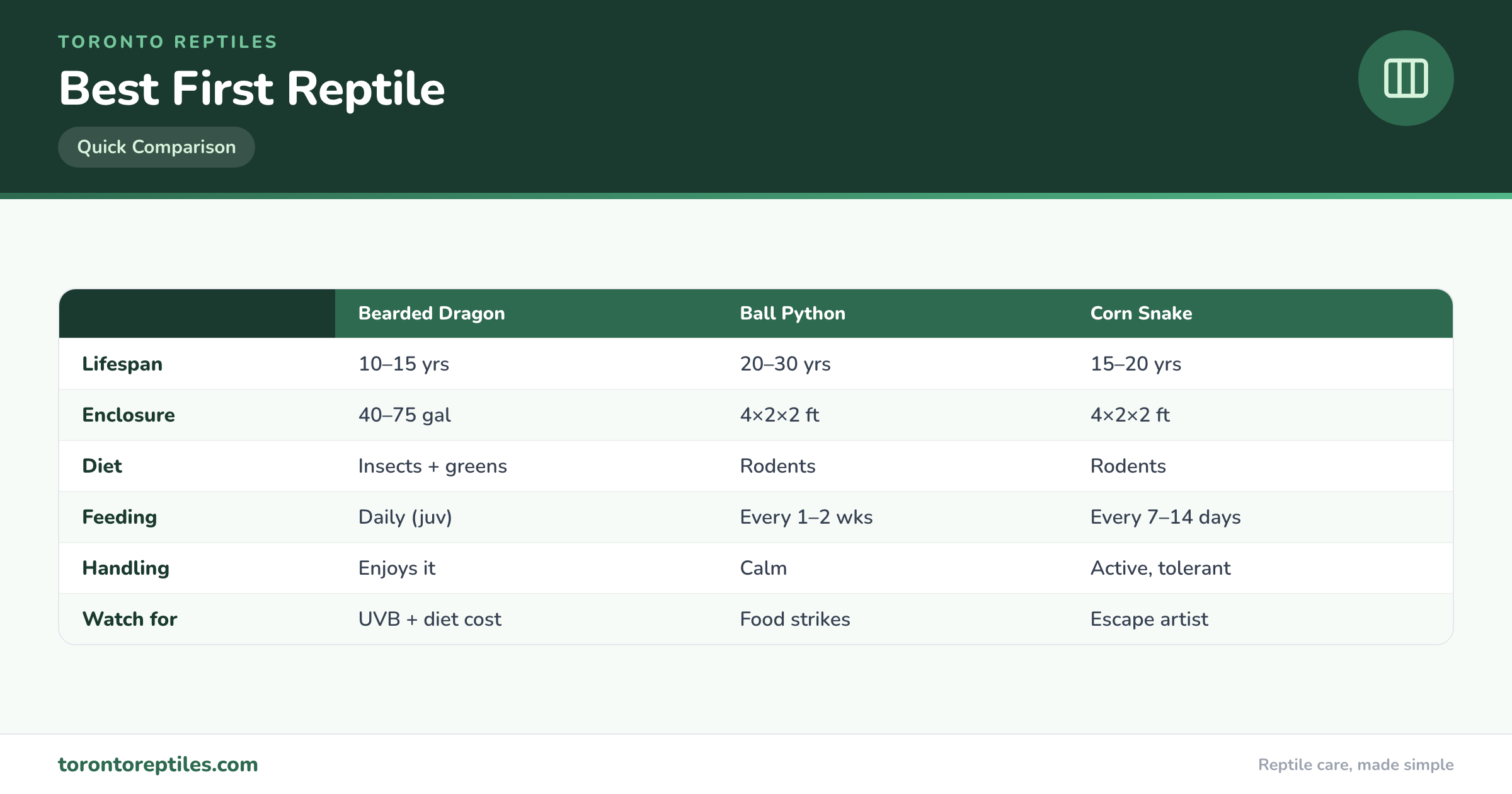
| Factor | Bearded Dragon | Ball Python | Corn Snake |
|---|---|---|---|
| Type | Lizard | Snake | Snake |
| Adult size | 16–24 inches | 3–5 feet | 3–5 feet |
| Lifespan | 10–15 years | 20–30 years | 15–20 years |
| Enclosure min (adult) | 75 gallon | 4 ft × 2 ft × 2 ft | 4 ft × 2 ft × 2 ft |
| Feeding frequency | Daily (juvenile) / 3x week (adult) | Every 1–2 weeks | Every 1–2 weeks |
| Food type | Insects + vegetables | Frozen-thawed rodents | Frozen-thawed rodents |
| Humidity | 30–40% | 60–70% | 40–60% |
| UVB needed | Yes, essential | Beneficial, not essential | Beneficial, not essential |
| Handling tolerance | Excellent | Very good | Excellent |
| Activity level | High (diurnal) | Low (nocturnal, hides often) | High (crepuscular/diurnal) |
| Up-front cost (CAD) | $600–$1,200 | $1,000–$2,300 | $880–$1,780 |
| Monthly cost (CAD) | $40–$80 | $15–$35 | $15–$30 |
Bearded Dragon: The Interactive One
Who they’re right for
The person who wants a reptile that acts more like a small, interactive pet. Bearded dragons are diurnal (awake during the day), they watch you, they come to the front of the enclosure when you approach, and they tolerate (often enjoy) handling. They’re the closest thing in the reptile world to a “social” animal.
What’s hard about them
They eat daily (as juveniles) and need a varied diet of live insects and fresh greens — more logistics than snake feeding. UVB lighting is non-negotiable and adds cost. Enclosure size (75 gallons minimum for adults) is significant. They can live 15 years.
What’s great about them
They’re engaging. They have personalities. Kids love them. They’re the reptile most likely to recognize you and respond to your presence — and that’s not projection; there’s decent research showing bearded dragons can individually distinguish between human caregivers.
Read our complete bearded dragon care guide for the full breakdown.
Ball Python: The Calm One
Who they’re right for
The person who wants a pet they can admire, handle occasionally, and not think about much day-to-day. Ball pythons are nocturnal, shy, and spend most of their time hiding. They feed every 1–2 weeks, meaning the “daily care” burden is almost nothing.
What’s hard about them
They’re famous for food refusal — healthy adults will occasionally skip 4–8 weeks of meals for no obvious reason, and first-time keepers find this stressful. They’re also not visible often, which can feel disappointing if you wanted an interactive pet. Humidity requirements (60–70%) are higher than corn snakes, requiring more setup attention in dry homes.
What’s great about them
When they do come out, they’re unbelievably calm. Handling a ball python is essentially stress-free — they’re relaxed, slow-moving, and rarely attempt to escape. They also have extraordinary morph variety (thousands of colour and pattern combinations) and are the most carefully captive-bred snake on the planet, meaning healthy, well-lineage animals are readily available.
Read our complete ball python care guide for the full breakdown.
Corn Snake: The Easy One
Who they’re right for
The person who wants a snake but not the quirks of a ball python. Corn snakes are active, curious, visible during the day, and almost never refuse food. They’re what most experienced keepers would actually recommend as a first snake — even though ball pythons outsell them in pet stores.
What’s hard about them
Very little. They’re genuinely easy. The main “challenge” is that they’re active and curious — if you wanted a snake that mostly stays put, corn snakes will be too energetic. They explore constantly, push against enclosure lids, and require secure housing (they’re known escape artists).
What’s great about them
Consistent feeders. Calm handlers. Visible during the day. Long-lived. Beautiful. Hundreds of colour morphs at accessible prices. If there’s a “Toyota Corolla” of pet reptiles — reliable, affordable, easy to live with — it’s the corn snake.
Read our complete corn snake care guide for the full breakdown.
Cost Comparison Over 15 Years
All three species have similar up-front setups. Where they diverge is ongoing cost — mainly driven by food and UVB.
| Category | Bearded Dragon | Ball Python | Corn Snake |
|---|---|---|---|
| Up-front (enclosure + animal + gear) | $800–$1,200 | $1,100–$2,300 | $880–$1,780 |
| Monthly food + utilities | $50–$80 | $20–$30 | $20–$25 |
| Annual vet + bulbs | $200–$400 | $150–$300 | $150–$300 |
| 15-year total (low estimate) | $12,700 | $6,650 | $6,030 |
| 15-year total (mid estimate) | $17,400 | $9,200 | $8,180 |
Bearded dragons are meaningfully more expensive to keep over a lifetime — more food, more UVB replacement, more electricity. Both snakes come in at roughly half the cost, partly because they eat so infrequently. For a full breakdown of what each species eats and how often, our reptile diet guide covers feeding schedules, prey size, and supplementation for bearded dragons, ball pythons, and corn snakes side by side.
The Honest Caveats
All three are long-term commitments
A bearded dragon is a 10–15 year animal. A ball python is a 20–30 year animal. A corn snake is a 15–20 year animal. Think about where you’ll be in 15 years — moving, having kids, travelling, changing careers. Whatever you pick, you’re committing to it through multiple life changes.
Species choice doesn’t matter as much as setup
All three species can thrive or struggle depending entirely on how well their enclosure is built. The single biggest predictor of a successful reptile pet isn’t species choice — it’s whether the keeper got the heat, humidity, and lighting right from day one. Don’t obsess over species. Obsess over getting the setup perfect. Our reptile enclosure setup guide is the right starting point for first-time keepers building from scratch — it covers sizing, heat gradients, UVB placement, and substrate for all three species here.
Pet store advice is often wrong
Pet stores routinely sell undersized enclosures, recommend outdated substrates (calcium sand, for example), and undersell care complexity. Buy your animal from a reputable breeder. Buy your equipment from specialty reptile shops or trusted online retailers. Trust breeder care sheets and modern husbandry communities over whatever the big-box store cashier told you.
What About Other Beginner Options?
This guide focuses on the three most commonly chosen species, but it’s worth noting the runners-up:
- Leopard gecko — excellent beginner lizard, smaller than beardies, don’t need UVB under traditional guidelines (though modern research favours it). Our complete leopard gecko care guide covers the full setup breakdown.
- Crested gecko — no live insects required (commercial diet available), very small enclosure, but shy and nocturnal. Our crested gecko care guide covers what that actually means in practice.
- Kenyan sand boa — even smaller and easier than ball pythons, but less interactive
- Hognose snake — small, interesting, very theatrical, but more specialized feeding. Our hognose snake care guide explains what that specialization actually involves.
For most first-time keepers, though, the bearded dragon / ball python / corn snake trio is the right place to start. The care communities are larger, the captive breeding is better, and the “what do I do?” resources are more accessible than for rarer species.
Frequently Asked Questions
Which of these is best for a 10-year-old?
Bearded dragon or corn snake, with adult supervision. Both tolerate handling well and are visible during the day. Ball pythons are too often hidden to hold a young kid’s attention.
Can I keep any of these in an apartment?
Yes to all three. None of them are noisy. A 4-foot snake enclosure takes up less wall space than a large bookshelf. Bearded dragons need more electrical draw (UVB + heat) but are still apartment-friendly.
Which is cheapest to keep?
Corn snake, by a narrow margin over ball python. Both are significantly cheaper than bearded dragons over a lifetime.
Is there a reptile that’s easier than all three of these?
Not really among standard pet reptiles. Leopard geckos come close but have their own quirks. The big three here are the baseline for accessibility.
What if I want to meet one before buying?
Spending time with the species in person is the best way to test compatibility. Lia, our bearded dragon, and our boas show exactly how differently lizards and snakes handle — and when you adopt through us, meeting the animal first is always part of the process.
Which one has the best “personality”?
Bearded dragon, by a mile. Snakes have personalities too — but they’re much subtler. If you want a reptile that visibly responds to your presence, go bearded dragon.
Can I have more than one?
Sure, but space each in their own enclosure. Beardies, ball pythons, and corn snakes are all solitary and should not be cohabited. Most keepers eventually end up with multiple reptiles in separate setups — it’s called “the collection” in the hobby, and it’s a pleasant trajectory.
Still Not Sure? Meet All Three in Person.
Reading about reptiles is no substitute for meeting one. Several ball pythons are looking for homes with us right now, and each listing describes temperament, feeding history, and setup honestly. Most people know which species fits them within minutes of spending time with a settled adult.
This guide describes general husbandry practices and isn’t a substitute for veterinary care — the Association of Reptile and Amphibian Veterinarians maintains a directory of qualified exotics vets. Reptiles can carry Salmonella even when healthy, so follow Health Canada’s handling and hand-washing guidance, especially around young children.